
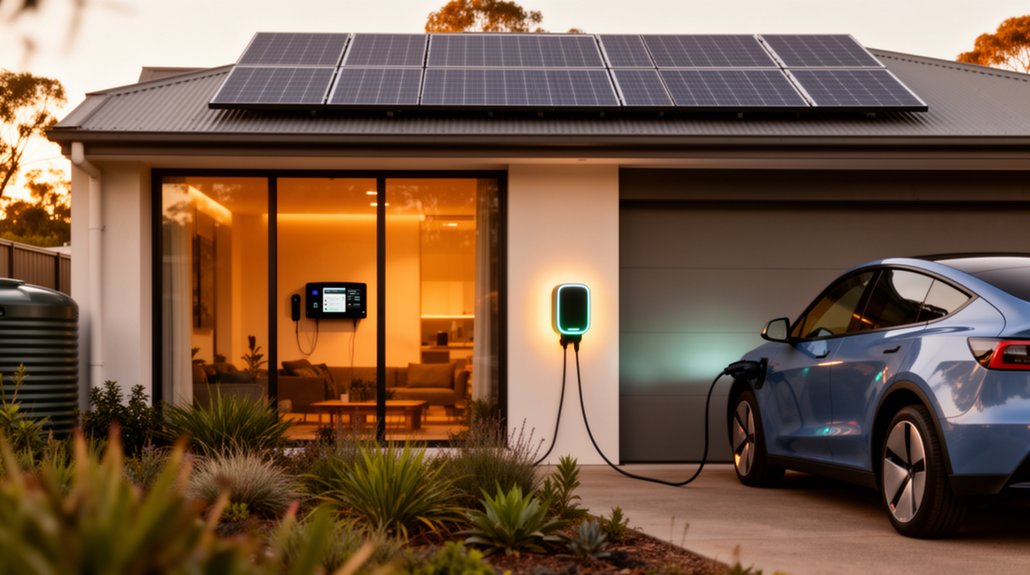
V2H integration turns your EV into a bidirectional, grid-synchronized home battery, so you’ll cut peak-rate costs with peak shaving and time-of-use shifting. You can store surplus solar from midday and discharge after sunset, boosting self-consumption and reducing low-value exports. With an approved inverter, anti-islanding controls, and a transfer switch, you’ll get silent, automatic backup during outages while protecting battery SOC for driving. Keep going to see what compatibility and payoff look like.
Key Takeaways
- V2H turns your EV into a home battery, supplying clean backup power during outages with automatic isolation and critical-load support.
- It cuts electric bills by charging off-peak and discharging during peak rates, optimizing time-of-use savings automatically.
- Smart load management caps peak demand, prioritizes essential circuits, and reduces demand charges or panel upgrade needs.
- Paired with solar, V2H stores midday surplus and powers evenings, boosting self-consumption and reducing low-value grid exports.
- It improves sustainability by maximizing renewable use, lowering generator reliance, and enabling resilient, low-emission energy independence.
What Is V2H Charging, and How Does It Work?
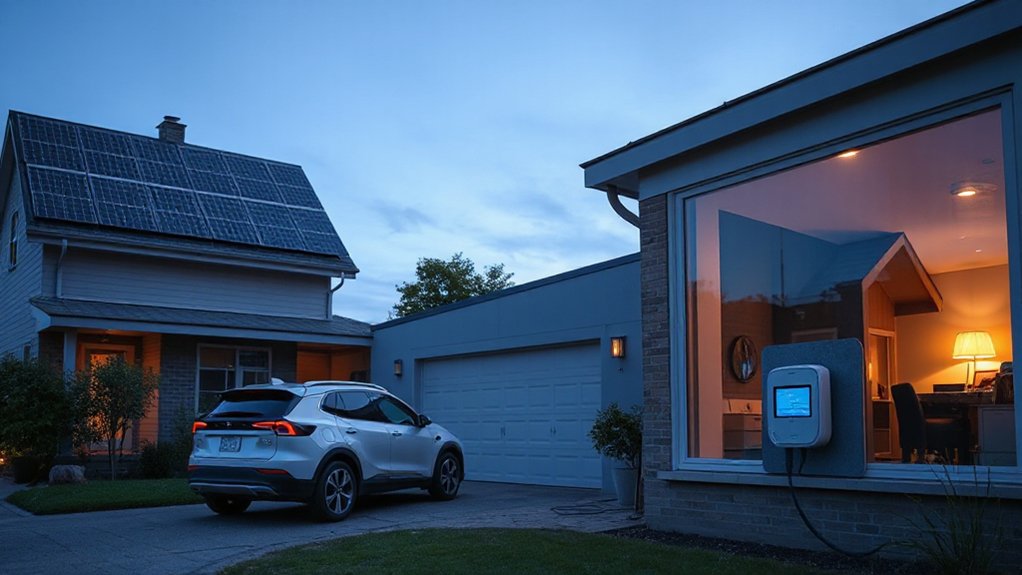
Although most EV charging flows one way—from the grid into your battery—vehicle-to-home (V2H) charging reverses that path so your EV can supply electricity to your house when you need it. You route DC energy from the traction pack through a bidirectional inverter that synchronizes with your home’s AC panel, then exports power to selected circuits or the whole load. Controls enforce anti-islanding, voltage and frequency limits, and battery protection thresholds, so you don’t backfeed a de-energized grid and you preserve pack health. With Battery storage effectively on wheels, you can shave peaks, ride through outages, and arbitrage time-of-use rates. Integrated energy management schedules charge and discharge based on tariffs, solar output, and minimum state-of-charge targets.
Is Your EV and Charger V2H-Compatible?
Before you plan a vehicle-to-home charging upgrade, you’ll need to confirm your EV explicitly supports V2H and that its firmware and connector standard align with bidirectional operation. You’ll also need a bidirectional-capable charger (not just a Level 2 EVSE) that’s certified for export to a home electrical system. Finally, you’ll want to verify your home setup—service panel capacity, transfer equipment, utility interconnection rules, and any required permits—so the system can operate safely and compliantly.
Check Vehicle V2H Support
First, confirm whether your EV and charging hardware actually support vehicle-to-home (V2H) operation, because most setups labeled “bidirectional” still require specific protocols, firmware, and approvals to export power to a home panel. Review your EV’s spec sheet for V2H/V2L/V2G capability, supported standards (for example, CHAdeMO or ISO 15118-based functions), and any OEM-required gateways. Check the model-year nuances: identical trims can differ by onboard inverter rating, DC pins, or software entitlements. Verify that your manufacturer allows stationary export in your region and that your battery warranty doesn’t restrict it. Align settings with Vehicle maintenance schedules so you don’t degrade cycle life. Also integrate V2H limits into Road trip planning to preserve departure state-of-charge and thermal headroom.
Confirm Charger Bidirectionality
After you’ve verified the vehicle-side V2H capability, you need to confirm that the charger can actually export energy to your home under the right standard and interconnection rules. Start by checking the unit’s certification for bidirectional operation, not just “smart charging.” Verify it supports your vehicle’s protocol stack (e.g., CHAdeMO or CCS with ISO 15118-20 where available) and that its firmware enables reverse power flow. For charger compatibility, match voltage/current limits, connector type, and approved operating modes listed by the manufacturer. Then perform bidirectionality confirmation by reviewing the commissioning documentation: grid-export settings, anti-islanding behavior, and utility-approved interconnect profile. Don’t rely on marketing labels; insist on test reports, UL/IEC listings, and an update policy that tracks evolving V2H standards.
Verify Home System Requirements
Even when your EV and charger support bidirectional power flow on paper, your home still has to meet electrical, control, and code constraints for V2H to work safely. You’ll need a service panel with adequate bus rating, spare breaker capacity, and verified fault-current limits. Install a listed transfer switch or certified isolation device so you don’t backfeed the grid, and confirm your utility’s interconnection rules. Your electrician should validate grounding, bonding, and surge protection for inverter-based sources.
Next, confirm your critical-loads subpanel matches your peak kW needs and that wiring gauges support sustained discharge. If you use Home automation, ensure your energy management system can coordinate TOU rates, islanding, and load shedding. Treat V2H as distributed Energy storage: plan for metering, firmware updates, and cybersecurity controls.
How V2H Cuts Bills With Peak Shaving
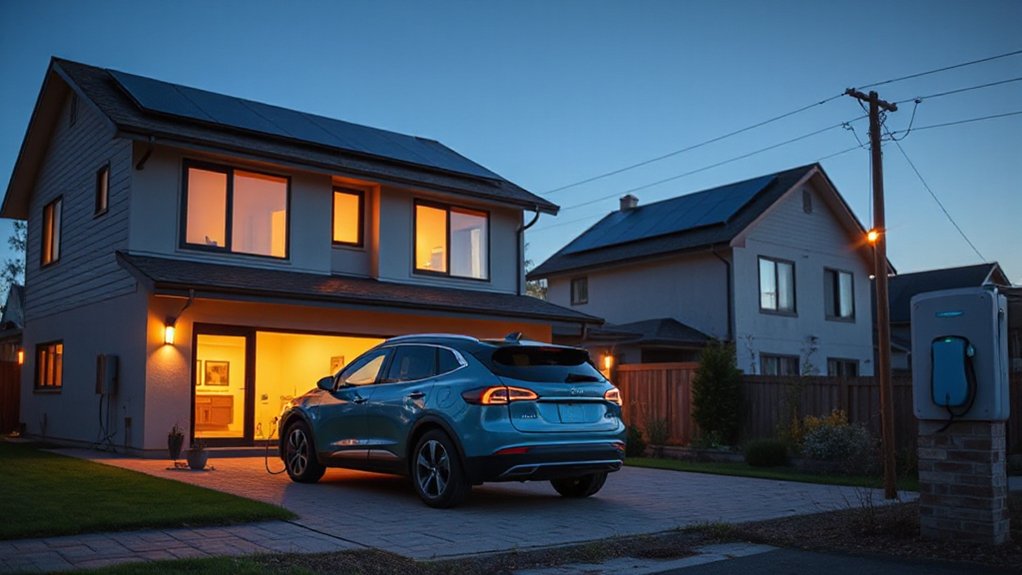
With V2H peak shaving, you’ll discharge your EV during high-load windows to reduce peak demand charges and cap your billing peak. You’ll also shift consumption under time-of-use tariffs by charging off-peak and powering the home on-peak, improving your effective energy rate. With smart load prioritization, you’ll keep critical circuits online while throttling discretionary loads, aligning comfort and resilience with utility price signals.
Peak Demand Charge Reduction
Why pay premium rates during the grid’s most stressed hours when your EV can cover those spikes? With V2H, you cap your home’s instantaneous draw by discharging the vehicle battery when HVAC, cooking, or fast appliance cycling would otherwise set a monthly peak. Many utilities assess demand charges based on the highest 15-minute interval; peak shaving targets that metric directly, lowering the billed kW even if total kWh stays similar. You effectively turn your car into dispatchable battery storage, coordinated by an energy management system that watches real-time load and inverter limits. Proper grid integration adds anti-islanding protection, export controls, and telemetry, so you reduce peaks without destabilizing service or violating interconnection rules.
Time-Of-Use Rate Shifting
Demand-charge peak shaving targets your highest 15‑minute kW, but Time‑Of‑Use (TOU) rate shifting targets the clock. With V2H, you charge when off‑peak pricing is lowest and discharge during peak windows, so you buy fewer high‑cost kWh. Your EV battery functions as distributed energy storage, converting tariff differentials into measurable savings without changing comfort.
You’ll configure schedules around your utility’s TOU periods, then let the bidirectional charger automate transfers with high round‑trip efficiency. Because TOU spreads are widening under renewable-heavy grids, this arbitrage grows more valuable each year. Strong grid integration also supports cleaner dispatch: you absorb midday solar oversupply and offset evening ramp demand. Verify interconnection rules and export limits, and you’ll keep savings predictable.
Smart Load Prioritization
Because most commercial and some residential tariffs penalize your single highest 15‑minute kW interval, smart load prioritization uses V2H to actively shape that peak instead of merely shifting energy by the clock. Your inverter and EMS forecast household demand, then discharge the EV battery to cap net draw below a programmed threshold while delaying or throttling flexible loads (EVSE, heat pump, water heater). You’ll reduce demand charges and avoid oversizing service panels, because the vehicle acts as fast-responding Energy storage. Priority rules keep critical circuits powered first, then allocate remaining kW to comfort loads without tripping breakers. When prices spike or a feeder constraint appears, the controller tightens the cap automatically. Over time, this peak-shaving strategy strengthens your Grid independence and keeps bills predictably low.
How V2H Pairs With Solar After Sunset
As rooftop solar output drops to near zero after sunset, a vehicle-to-home (V2H) system can shift the surplus you generated earlier into the evening by discharging your EV battery to support household loads. With bidirectional charging, you effectively treat the EV as a high-capacity solar battery, time-shifting kilowatt-hours that would’ve been exported at low value into onsite consumption. You’ll configure a discharge window aligned to peak rates, then let your inverter and energy management system hold frequency and voltage while the car supplies steady power. This pairing improves self-consumption, reduces grid imports, and stabilizes your home’s load profile during high-demand hours. You’ll monitor state-of-charge limits so you preserve driving range while meeting predictable nighttime energy needs.
How V2H Keeps Lights On During Outages
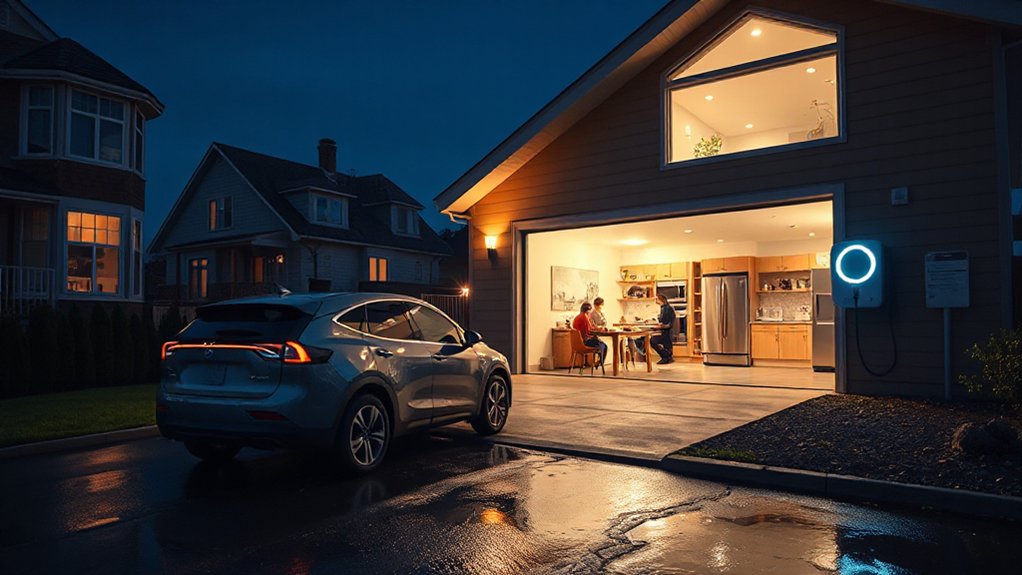
Time-shifting solar with V2H also sets you up for resilience when the grid goes down. When an outage occurs, your bidirectional charger isolates your home from the utility via an automatic transfer switch, then draws DC energy from the EV battery and converts it to stable AC for essential circuits. You’ll keep refrigeration, lighting, networking, and medical devices running without a portable generator’s noise or emissions. Configure load-shedding so high-demand appliances don’t exceed inverter limits, and set reserve state-of-charge thresholds so you don’t strand yourself. This capability strengthens Emergency preparedness by turning a parked vehicle into a managed backup resource. With Renewable energy integration, you can prioritize solar recharge during daylight and coordinate with home energy management to sustain operation through extended disruptions.
When V2H Pays Off Most for Homeowners
Although bidirectional charging still carries upfront hardware and permitting costs, V2H pays off fastest when you can monetize flexibility: offseting peak-rate imports under TOU tariffs, capturing more on-site solar by storing midday surplus in the EV, and reducing the need for a standalone home battery while maintaining outage backup. You’ll see the strongest economics if your utility has steep peak spreads, export limits, or frequent curtailment credits. You can also improve payback when your driving is predictable, so you can cycle the pack without risking morning range. Manage Vehicle maintenance by tracking charge/discharge throughput and keeping SOC windows conservative to limit degradation. Optimize Charging station placement near the service panel to reduce conduit runs, voltage drop, and installation labor. Integrate EMS controls so dispatch follows price signals and load priorities.
Frequently Asked Questions
Do I Need Utility Approval or Permits to Install a V2H System?
Yes, you’ll typically need utility approval and permits. You must follow Utility regulations for interconnection and comply with local permit requirements for electrical work, transfer equipment, and inspections. Your installer coordinates filings and commissioning tests.
Will V2H Charging Void My EV Warranty or Affect Lease Terms?
It can—but only if you overlook the fine print. You’ll typically keep coverage using OEM-approved hardware and settings; otherwise, Warranty considerations apply. For leased EVs, expect Lease restrictions on bidirectional use. Check contract, confirm with dealer.
How Does V2H Impact Battery Degradation and Long-Term Resale Value?
V2H can slightly accelerate degradation if you cycle deeply, but you can protect battery longevity by limiting depth-of-discharge and heat. Managed correctly, it preserves resale value, and smart-energy buyers increasingly view it as advantageous.
Can V2H Work With My Existing Home Electrical Panel and Wiring?
Yes, V2H can work—when you verify Electrical compatibility. Like a circuit finding its match, you’ll need a transfer switch, inverter, and load management; your home wiring must meet code and capacity limits.
What Maintenance, Software Updates, and Ongoing Fees Should I Expect?
You’ll handle minimal hardware checks annually, apply OTA firmware/app updates quarterly, and budget subscription or utility fees. Battery lifespan depends on cycling; follow OEM limits. Cost considerations include service calls, inverter warranties, and cybersecurity monitoring.
Conclusion
With V2H, you turn your EV into a bidirectional energy asset that supports cost control, solar self-consumption, and resilience. You’ll verify EV and charger compatibility, then dispatch stored kWh for peak shaving and evening loads, like a smart capacitor smoothing demand. When the grid fails, you’ll maintain essential circuits with controlled islanding and safe transfer. V2H pays off fastest where TOU rates, frequent outages, or high PV export limits drive value.
About the Author