
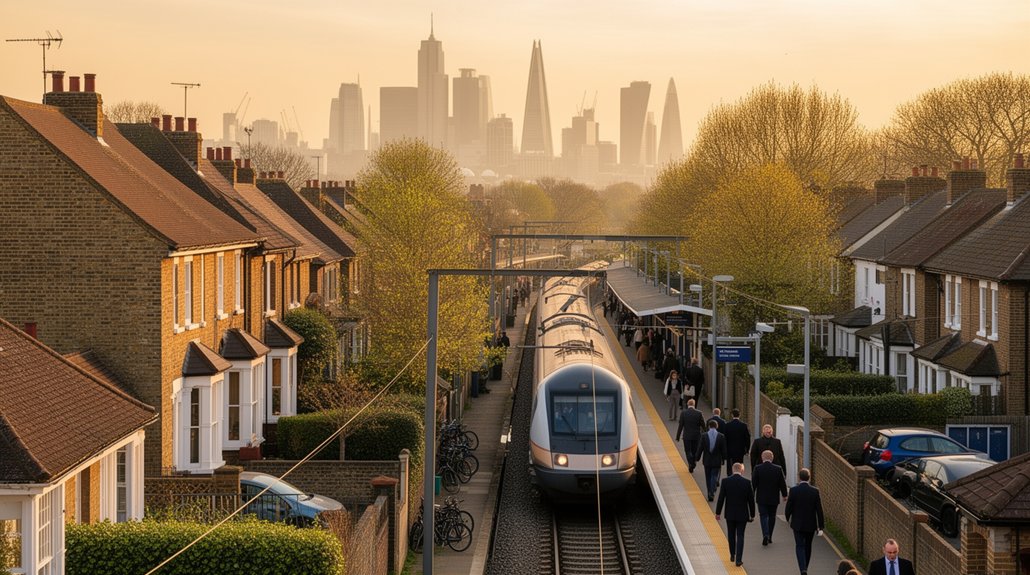
You’ll get the best commuter value by choosing counties where you can walk to a station with 4+ trains/hour, limited-stop services, and manageable season or flexi fares. Kent wins for sub-50-minute runs to London Bridge, while Essex (Elizabeth Line) offers predictable Liverpool Street access. Thameslink makes Bedfordshire strong for King’s Cross and the City. Hertfordshire stays quick with lower entry prices, and Buckinghamshire can cut fares via Chiltern if you accept longer times; next, see which towns and stations outperform.
Key Takeaways
- Rank counties using a weighted index combining housing costs, council tax, rail fares, and commute times into central London.
- Kent offers some of the fastest, best-value links to London Bridge, with several towns delivering sub-50-minute journeys.
- Essex Elizabeth Line towns like Brentwood and Shenfield provide frequent, predictable services to Liverpool Street with practical, walkable amenities.
- Bedfordshire and nearby counties on Thameslink (e.g., Luton, Harpenden) offer high-frequency trains to King’s Cross and Farringdon with improving reliability.
- Maximise value by living within 10 minutes of a station and using Railcards, season/flexi tickets, and fare boundary advantages to cut costs.
Best-Value London Commuter Counties: How We Ranked Them
To rank the best-value commuter counties for Central London, we built a weighted scoring model that balances what you pay (typical house prices, rents, and council tax) against what you get (fast, reliable rail links, peak-time travel costs, and station coverage), then adjusted for day-to-day liveability metrics like broadband speeds, safety indicators, and access to green space. You’ll see each county compared on a single index, so you can scan options without drowning in spreadsheets. You get transparent inputs, consistent time windows, and the same station-to-Zone-1 assumptions across the map. You can replicate the results: swap weights to match your priorities, then re-rank instantly. We also stress-tested the shortlist using commuting technology signals (service alerts, disruption frequency) to reflect real mornings. That keeps your work life balance in view, not just headline prices.
The 4 Metrics That Decide “Value” (Price, Time, Fares, Livability)
- Price: target Affordable housing plus predictable council tax bands.
- Time: prioritise consistent timetables, lower delay minutes, and fewer interchanges.
- Fares: compare peak caps, railcard effects, and parking add-ons.
- Livability: verify commuter amenities, walkable centres, and reliable fibre speeds.
Use a simple 0–10 dashboard so trade-offs stay visible and decisions stay defensible.
Kent: Fastest Southeastern Commutes to London Bridge
If you’re targeting London Bridge, Kent gives you some of the Southeast’s shortest rail times, especially on Southeastern and Thameslink corridors with limited-stop patterns. You’ll compare quickest routes with median sale prices and season-ticket costs to spot top-value towns where the minutes saved don’t inflate your budget. You’ll also get peak-time tactics—right train, right station, right departure window—to keep journeys reliable and avoid the worst crowding.
Quickest Kent Rail Routes
While Kent sprawls from commuter towns to coastal hubs, Southeastern’s fastest rail links to London Bridge cluster around the North Kent and Main Line corridors, where limited-stop patterns and frequent peak services keep journey times competitive. You’ll typically see sub-50-minute runs from key stations, with the biggest swings driven by dwell time, junction conflicts, and pathing into the core.
- Choose limited-stop peak trains to cut 5–15 minutes versus all-stations patterns.
- Track performance: aim for high PPM and low cancellation rates to protect reliability.
- Prioritise rail infrastructure touchpoints—fast lines, grade separation, and modern signalling.
- Optimise your last mile: station access, cycle storage, and bus interchange lift commuter satisfaction.
Check real-time load indicators and timetable PDFs, then lock in a service with consistent headways and predictable platforms.
Top Value Commuter Towns
Because journey time only matters when the price stack works, the best-value Kent commuter towns for London Bridge pair sub‑50‑minute Southeastern runs with sensible housing costs, strong service frequency, and low disruption risk.
Start with Gravesend and Dartford: you’ll often hit London Bridge in ~35–45 minutes, with dense timetables that protect your commuter lifestyle. Look at Tonbridge for fast mainline options and a well-designed town centre that keeps walk-to-station time low. Consider Sevenoaks only if your budget stretches; speeds are great, but residential affordability drops sharply. For value-plus-space, try Rochester/Chatham: slightly longer runs, yet bigger housing stock and strong amenities. Validate with two checks: daily train-per-hour, and typical door-to-platform time from your target neighbourhood.
Peak-Time Travel Tips
The best-value town choice only pays off when your peak-time routine runs predictably, so optimise for the fastest Southeastern paths into London Bridge and the failure points that slow them down. Kent’s quickest patterns cluster on the High Speed and mainline corridors; minutes saved compound across five days, especially under Peak hour congestion.
- Pick trains with fewer dwell stops; each extra stop typically adds 2–4 minutes plus crowding delay.
- Stand by the correct London Bridge car position; you’ll cut platform-to-exit time by ~3–6 minutes.
- Buffer one earlier service twice weekly; it protects you against 10–20 minute knock-ons from junction conflicts.
- Build alternative travel methods: keep a fallback route via Cannon Street, plus a bike or bus link for the last mile.
Essex: Elizabeth Line Value Towns for Central London
Two Elizabeth Line stops in Essex—Shenfield and Brentwood—stand out for commuters who want Central London access without paying Zone 1–2 prices: you get direct, high-frequency rail into Liverpool Street and the West End, predictable journey times, and a station-led lifestyle where walkable high streets, schools, and parking options cluster around the platforms, making these towns practical picks when you’re optimising for cost, reliability, and door-to-door time. For Commuter affordability, compare total monthly outlay: rail fares plus parking or bus links, then stress-test with 2–3 late-evening returns. Transportation infrastructure is the differentiator: step-free access, wider platforms, real-time boards, and frequent all-day service reduce missed connections. You’ll also get more choice in housing stock within a 10–15 minute walk, cutting taxi spend and making your commute resilient.
Bedfordshire: Thameslink Routes Into King’s Cross and City
If you want a fast, repeatable commute into King’s Cross, Farringdon, or City Thameslink without paying inner-London housing premiums, Bedfordshire’s Thameslink towns—especially Luton, Harpenden, and Flitwick—deliver high-frequency, all-day service with straightforward connections and predictable runtimes. You benefit from upgraded rail infrastructure on the Midland Main Line, plus through-running that cuts transfers and reduces failure points. Typical peak journeys into central hubs stay within commuter-friendly windows, and service density helps you recover quickly when disruption hits. For value, you’ll want walkable station catchments and simple bus links that keep door-to-door time stable. Prioritise:
- Peak trains per hour and stopping patterns
- Step-free access, cycle storage, and platform layout
- Season-ticket pricing versus time saved
- On-time performance trends and commuter satisfaction
Hertfordshire: Short Commutes With Lower Entry Prices
While Zone 1–2 prices keep climbing, Hertfordshire gives you shorter rail hops into King’s Cross, Moorgate, and the West End with noticeably lower entry costs in many station catchments. You’ll typically see sub‑40‑minute fast services from key hubs, making door‑to‑desk planning easier and reducing late‑train risk.
For Affordable housing, focus on walkable stations with frequent stopping patterns, then compare season-ticket costs against marginal mortgage savings. You can design a low-friction routine by prioritising step-free access, sheltered cycle storage, and direct bus links for the last mile. Expect commuting challenges at peak times—platform crowding, limited parking, and occasional service curtailments—so you’ll want flexible hours, backup routes, and a home office nook for disruption days.
Buckinghamshire: Chiltern Line Savings vs Travel Time
Because the Chiltern Main Line often undercuts faster mainline routes on fares, Buckinghamshire can deliver meaningful monthly savings into Marylebone (and, via the Bakerloo/Jubilee, the West End and City) even when your door‑to‑desk time stretches past a comparable Hertfordshire run. You’ll trade a few extra minutes for steadier costs, especially from High Wycombe, Princes Risborough, or Gerrards Cross. Use a simple travel time comparison: platform-to-platform is often 10–20 minutes longer, but the fare delta can meaningfully cut annual spend.
- Price season tickets and flexi options for Chiltern Line savings
- Check peak vs off‑peak differentials and railcard eligibility
- Map last‑mile links at Marylebone to your workplace entrances
- Prioritise housing within a 10‑minute walk of the station
Surrey: Greener Living With Still-Manageable Season Tickets
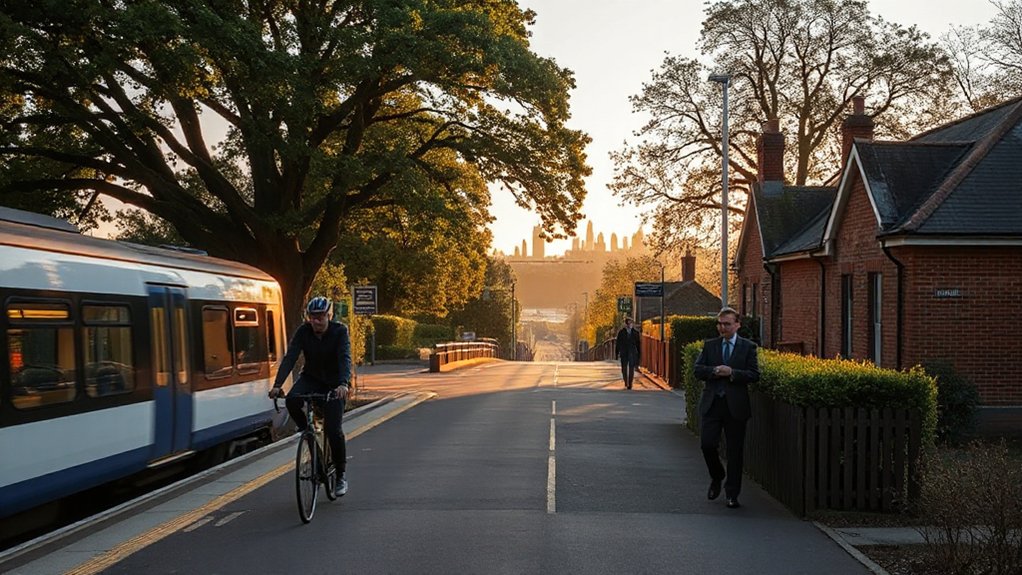
In Surrey, you can base yourself in leafy towns where the station sits within an easy walk of parks, high streets, and new-build hubs. Season-ticket pricing isn’t uniform, so you’ll want to target specific “cost pockets” where annual fares stay relatively manageable for the mileage. You still get fast, frequent links into Waterloo, Victoria, and London Bridge, keeping your door-to-desk time competitive.
Leafy Towns Near Rail
If you want more greenery without giving up a workable Central London commute, Surrey’s rail-linked towns hit a strong design-and-data sweet spot: higher tree cover, larger housing plots, and faster access to key termini (typically Waterloo, Victoria, or London Bridge) than many similarly “leafy” options farther out. You’ll see Tree lined neighborhoods that read as intentional urban design: consistent verges, protected sightlines, and calmer traffic. Station-centric high streets keep daily trips short, while green buffers (commons, parks, river walks) add usable open space, not just scenery. Prioritise places where the walk-to-rail catchment stays tight and amenities cluster logically around it:
- 10–15 minute station walks
- Frequent peak services and reliable dwell times
- High street density plus Community amenities
- Parks/commons within a 5-minute loop
Season Ticket Cost Pockets
Where can you still buy Surrey’s greener streetscape without letting rail costs erase the value? Look for “season-ticket cost pockets” where annual passes stay below the county’s peak, yet you still get tree-heavy streets, pocket parks, and low-rise centres that feel designed for walking. Start with a fare comparison across adjacent stations, because boundary pricing can swing markedly within a few miles. Then price your real pattern: 3–4 days in-office often beats a full annual, especially when Season ticket discounts stack with Railcard, part-time, or carnet products. Use postcode-to-station mapping to keep the walk or cycle under 15 minutes, so you don’t add parking fees. Finally, check zones, operator splits, and Oyster/Contactless caps before you commit.
Fast Links To London
Season-ticket cost pockets only pay off when the train time stays competitive, so Surrey’s best-value picks tend to sit on fast mainline corridors with limited-stop services into Waterloo, Victoria, or London Bridge. Target stations where timetable data shows 30–45 minute peaks and 4+ trains per hour, so you’re buying reliability, not just a postcode. You’ll also benefit from Public transport innovations that reduce end-to-end friction and enable commuter lifestyle improvements without London rents.
- Choose hubs with step-free access, wide gates, and clear wayfinding
- Prioritise direct services over “same time” options with extra interchanges
- Check live-performance dashboards: delay minutes, cancellation rates, platform changes
- Pair rail with safe cycle parking, e-bike hire, and bus links for last-mile design
Hampshire: Best for 2–3 Days/Week London Commuters
Although Hampshire sits beyond the classic commuter belt, it hits a sweet spot for 2–3 days/week in London: fast rail links from hubs like Winchester, Basingstoke, and Fleet typically get you into Waterloo in roughly 45–70 minutes, while local housing costs often undercut inner Surrey and west London equivalents.
You’ll get better commuter housing per square foot, especially in modern flats near stations and 3-bed homes on 1970s–2000s estates with predictable layouts and parking. Target walkable catchments: 10–15 minutes to rail, supermarkets, gyms, and schools so you’re not car-dependent. For local amenities, prioritize town centres with all-day bus loops and coworking space for non-London days. If you drive, A3/M3 access lets you hedge against rail disruption. Check season-ticket pricing versus off-peak flexi options.
Frequently Asked Questions
What Salary Do I Need to Comfortably Commute Into Central London?
You’ll typically need £40k–£60k to commute comfortably into Central London, covering season tickets and daily costs. Choose affordable housing near stations, prioritize local amenities, and cap commuting plus rent at ~35% of take-home.
Can I Combine Railcard Discounts With Season Tickets for Commuters?
You usually can’t combine Railcard combos with most Season Tickets; discounts apply to Off-Peak/Anytime singles/returns, not standard seasons. You can, however, buy a discounted Travelcard in limited cases. Check Ticket flexibility rules.
How Do Hybrid Work Patterns Change the Best-Value County Choice?
Hybrid habits halve travel, so you’ll prioritize cheaper housing over peak fares. With more remote work, you can tolerate longer journeys if transportation infrastructure’s reliable. You’ll model weekly commute days, season costs, and time.
What Are the Best Strategies to Reduce Peak-Time Commuting Costs?
Use Flexible schedules to shift off-peak fares; you’ll cut ticket costs 20–40% on many routes. Lock in season or carnet discounts, combine railcard deals, and test Carpool options for last-mile segments.
How Reliable Is Mobile Signal and Wi‑Fi on These Commuter Routes?
Signal bars are your green lights: you’ll get generally reliable Mobile coverage and Wi Fi connectivity on mainlines, but expect tunnel and rural dips. You can improve uptime by using 4G/5G failover and offline-first apps.
Conclusion
You don’t need to guess which commuter county gives you the best value—you can rank it. When you weigh median prices, door-to-door time, season-ticket costs, and livability, the trade-offs become clear. Kent and Essex win on speed and new rail capacity; Hertfordshire and Bedfordshire balance time with entry price; Buckinghamshire and Surrey reward you with space and greenery; Hampshire fits hybrid schedules. Use the metrics like a dashboard, so your choice stays on track.
About the Author