
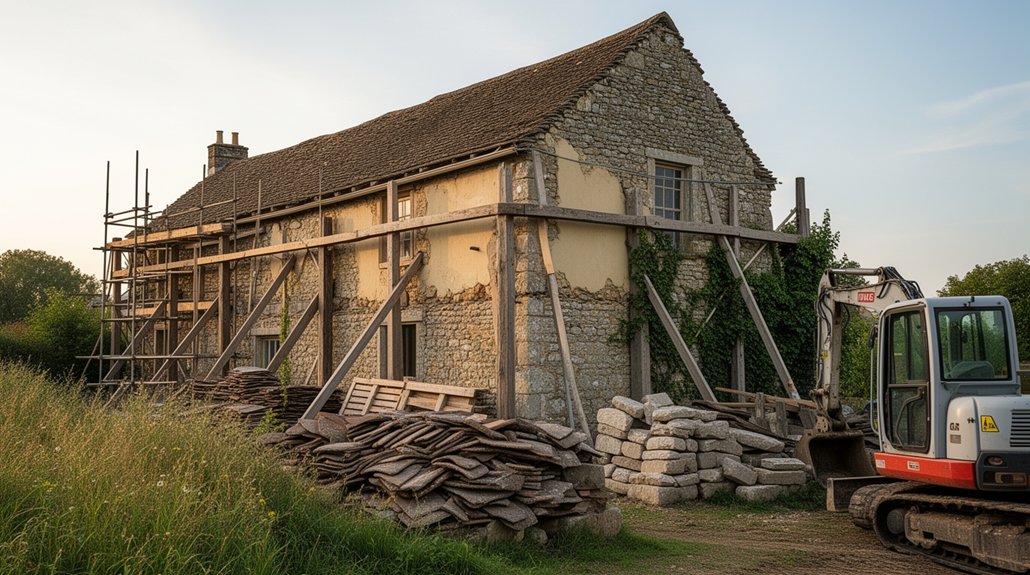
Across many rural surveys, you’ll find that over 60% of ruined farmhouses fail first at the roof and wall heads, not the foundations. You start by proving what’s still structurally sound, then you shore walls, brace openings, and cap vulnerable masonry before one more storm pulls it apart. You manage water with drainage and ventilation, not hard sealants that trap damp. Only then do you rebuild with lime, original stone, and seasoned timber—but the next decision is the one that can’t be reversed…
Key Takeaways
- Assess load paths, settlement, and lateral resistance; decide whether defects are local repairs or require selective reconstruction.
- Stabilise immediately with rakers, strongbacks, and temporary roof props, working from sound bearings and monitoring plumb daily.
- Control water fast: cap wall heads, clear valleys, reinstate gutters, and regrade ground to drain away from foundations.
- Rebuild with compatible materials: salvage stone, use vapor-open lime mortar, remove hard cement pointing, and stitch cracks discreetly only where needed.
- Integrate modern services reversibly through voids or battens, keep access for maintenance, and use low-temperature heating to protect historic fabric.
Is Your Ruined Farmhouse Structurally Salvageable?
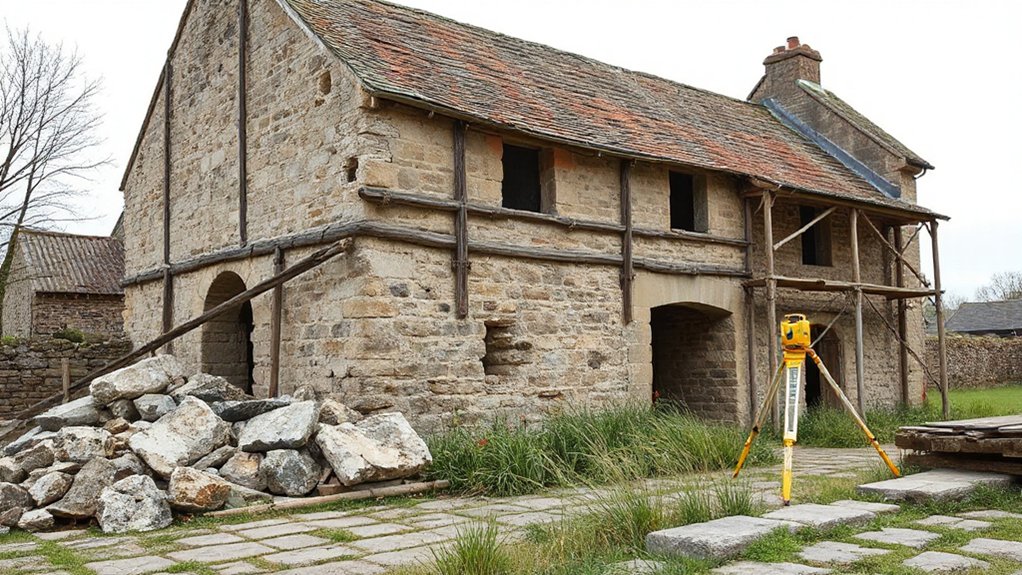
Before you start budgeting for a rebuild, you need to confirm the farmhouse’s structural shell is worth saving by evaluating its load paths, material integrity, and foundation performance. Trace gravity loads from roof to walls to footings and note discontinuities from removed beams, altered openings, or racked frames. Probe timber for rot and insect galleries; check masonry for delamination, powdering mortar, and bulging wythes. Measure out-of-plumb walls and differential settlement; map cracks, then correlate them with drainage, soil, and footing depth. Verify lateral resistance by inspecting diaphragm connections, tie rods, and wall-to-floor anchors. If defects are localized and repairable, you can pursue Historic preservation and aesthetic restoration; if global instability dominates, selective reconstruction may be safer and more defensible.
Stabilise the Ruined Farmhouse: Shoring, Roof, Openings
Once you’ve decided the shell is worth saving, stabilise it immediately so wind, rain, and vibration don’t turn repairable damage into progressive failure. You’ll start with reversible measures that respect Farmhouse preservation and protect Historical accuracy while you plan permanent works.
- Shore leaning walls with timber rakers on sole plates, tightening wedges until cracks stop “talking” under load.
- Brace floors and gables with diagonal strongbacks, then strap ties to keep corners from peeling apart.
- Make the roof safe: prop sagging purlins, sister fractured rafters, and install a temporary ridge support to halt spread.
- Secure openings: needle-lintel failed heads, screw ply over windows and doors, and keep originals labelled for reinstatement.
Work from sound bearing points, record every intervention, and check plumb daily.
Stop Water Ingress Without Sealing In Damp
With the shell shored, braced, and temporarily supported, you can now tackle the threat that quietly destroys repairable fabric: uncontrolled water entry. Start at the top: fit temporary flashings, cap exposed wall heads, and divert roof run-off into gutters and downpipes that discharge well clear of foundations. Clear debris from valleys and hollows so water can’t pond.
At ground level, prioritise Exterior drainage before you reach for Waterproof membranes. Regrade soil away from walls, cut back banks, and form shallow swales to intercept hillside flow. Add a French drain only where you can guarantee fall and an outlet; otherwise you’ll create a saturated trench. Keep internal surfaces breathable: ventilate, maintain airflow, and avoid continuous interior tanking that traps moisture and salts.
Repair and Rebuild With Original Stone, Lime, and Timber
Although modern mortars and treated timbers look like quick fixes, you’ll get a longer-lasting rebuild by matching the farmhouse’s original materials and the way they manage moisture and movement. Salvage and sort fallen stone by type and bedding face, then rebuild lifts in lime mortar that stays vapour-open and accommodates slight settlement. Rake out hard cement pointing, re-point flush or slightly recessed, and keep joints sacrificial for stone preservation. Stitch cracks with stainless helical bars only where needed, hiding intervention within joints. For floors and roofs, choose seasoned, locally compatible species; scarf in splices rather than replacing whole members, and treat only where decay’s active to respect timber restoration.
- You’ll feel the walls breathe again.
- You’ll hear fewer winter creaks.
- You’ll smell dry lime, not rot.
- You’ll see honest repairs.
Add Electrics, Plumbing, and Heat With Minimal Disruption
If you route services as lightly as possible, you can modernise electrics, plumbing, and heat without turning vapour-open stonework into a chased-and-cemented sponge. Run cables and pipes in floor voids, behind skirtings, or within new service battens fixed to timber, not into masonry. Use surface-mounted conduit in secondary spaces and hide junctions in accessible cupboards, so fault-finding won’t require demolition. For water, choose multi-layer pipe with demountable fittings, add isolation valves per zone, and sleeve every penetration to prevent lime cracking. Heat gently: low-temperature radiators or wall-mounted emitters, fed by an air-source pump, preserve historic fabric; avoid retrofitted underfloor where floors must breathe. Pair Vintage fixtures with Sustainable materials for longevity, repairability, and reversible upgrades.
Frequently Asked Questions
How Long Does a Sensitive Farmhouse Rebuild Typically Take From Start to Finish?
You’ll typically need 12–24 months from survey to handover, depending on modern techniques, permitting, weather, and preservation challenges. You’ll spend 3–6 months on design/approvals, then 9–18 months on structural, envelope, and fit-out works.
What Permissions or Heritage Consents Are Required Before Stabilisation Begins?
You’ll typically need planning permission and listed-building or heritage consent before you start, plus archaeological clearance if required. You must coordinate Historical preservation requirements, submit method statements, and satisfy Building regulations for temporary works and safety.
How Can I Estimate Costs When Hidden Structural Damage Is Likely?
For cost estimation amid likely hidden issues, you’ll commission phased damage assessment, open up small inspection areas, and use contingencies (15–30%), provisional sums, and rate-based allowances. You’ll reprice after surveys, trials, and engineer input.
Will Rebuilding Affect Property Insurance, Mortgages, or Future Resale Value?
Yes—rebuilding can change coverage, lending terms, and resale. You’ll face Insurance implications for occupancy, rebuild value, and code upgrades; mortgage considerations include lender draw schedules, inspections, and appraisal resets impacting future sale pricing.
How Do I Source Reclaimed Materials That Match the Original Farmhouse Character?
Start with Local salvage yards, architectural reclaim dealers, and demolition auctions; bring photos, profiles, and species ID to guarantee Material matching. You’ll verify patina, moisture content, dimensions, and fixings, and request provenance documentation.
Conclusion
You’ve proven a ruined farmhouse isn’t a lost cause; it’s a load path waiting to be reconnected. By shoring walls, securing rooflines, and protecting openings, you’ve halted progressive collapse. By managing water with drainage, ventilation, and lime-based, vapour-open repairs, you’ve stopped decay without trapping damp. Reusing original stone and seasoned timber keeps the fabric legible. When you thread in services discreetly, you let modern comfort ride quietly within historic bones, built to endure.
About the Author