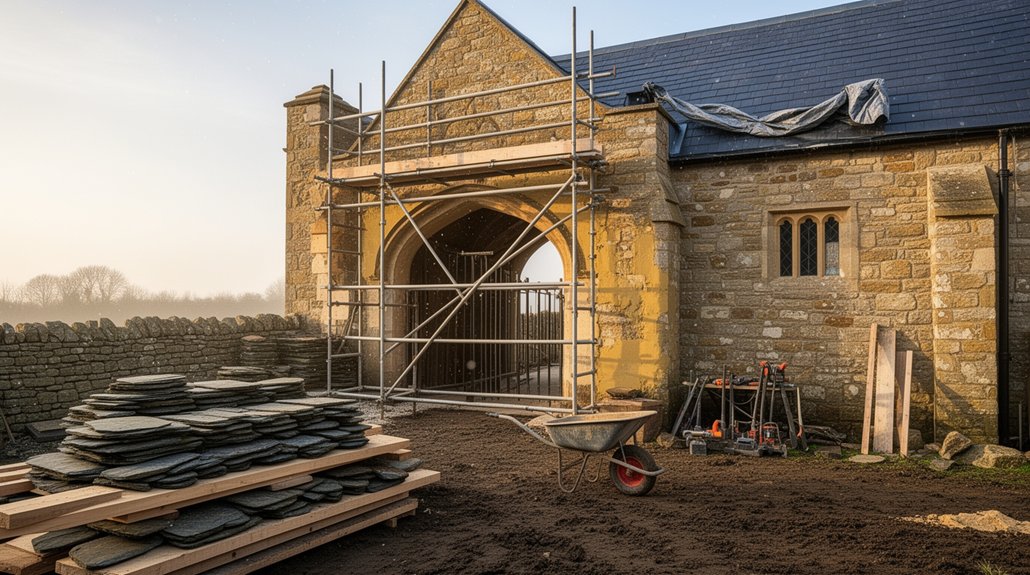
You probably don’t know that much “damp” in a stone gatehouse is driven by cement pointing and poor drainage, not the stone itself. You’ll need a measured survey, moisture profiling, and a roof-and-rainwater check before you touch finishes, then you must line up Listed Building Consent and agree a lime-based repair strategy. If you route services or add insulation without a vapour-open plan, you can lock moisture in and accelerate decay—so what comes first?
Key Takeaways
- Commission a measured survey and condition report to map structural movement, mortar decay, roof defects, and damp pathways before designing repairs.
- Secure Listed Building Consent and any planning permission with scaled drawings, heritage statement, and detailed method statements before starting work.
- Repair stonework and repoint using compatible lime mortars; avoid hard cement, and cure slowly to protect arrises and maintain breathability.
- Fix damp at source by maintaining rainwater goods, lowering external ground levels, adding French drains where suitable, and improving ventilation routes.
- Upgrade services and finishes reversibly using minimal penetrations, surface conduits, vapour-open lime plasters, and breathable insulation like woodfibre or calcium silicate.
Survey Your Stone Gatehouse: Structure, Damp, Roof
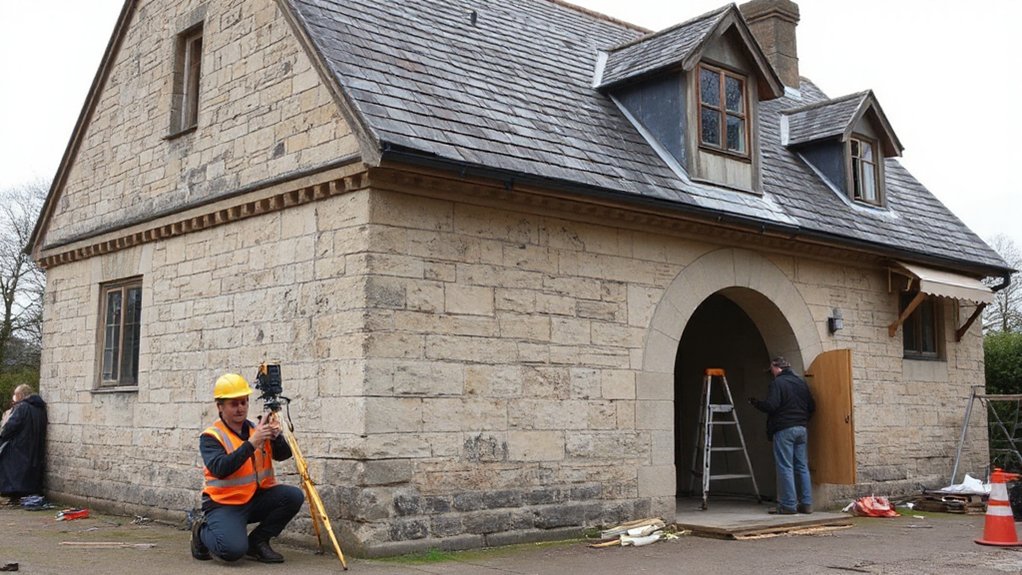
Where do you start with a stone-built gatehouse? You commission a measured survey and condition report, then walk the fabric methodically. Check load paths: bulging elevations, stepped cracking around openings, lintel deflection, and movement at quoins. Inspect mortar type and erosion to plan Stone preservation; avoid hard cement where lime’s required. Map damp with moisture profiles, not guesswork: look for defective rainwater goods, bridged DPCs, ground levels against walls, and internal salt bloom. Confirm ventilation routes and timber decay at embedded beam ends. For the roof, you inspect coverings, lead flashings, valleys, and ridge bedding, and you lift sample slates to assess battens and underlay. Specify Roof restoration that retains original slate, renews fixings, and improves drainage.
Get Listed Building Consent and Planning Sorted
Once you’ve surveyed the gatehouse, you need to lock down the statutory consents before you touch fabric: if it’s listed, you’ll apply for Listed Building Consent via your local planning authority with scaled drawings, a heritage statement, and a schedule of works. You’ll also confirm whether planning permission is required for the proposed alterations or change of use, checking local plan policies, conservation area constraints, and any permitted development limits. Get early advice from the conservation officer, align your applications, and programme for validation, consultation, and determination timescales.
Listed Building Consent Steps
Although you might feel ready to start stripping back plaster or opening up stonework, you’ll need to lock down Listed Building Consent (LBC) and any linked planning permission before you touch the fabric of a stone-built gatehouse. Start with pre-app advice from your Local Planning Authority’s conservation officer, then commission a measured survey, condition report, and heritage statement explaining significance and impact for Historic preservation. Submit scaled drawings, method statements, and a schedule of works covering repairs, reversibility, and junction details. Justify Material selection with like-for-like specifications (lime mortars, stone type, timber species), sample panels, and supplier data. Include photos, annotated elevations, and any structural engineer input. Track validation, respond fast to queries, and don’t start enabling works until consent’s issued.
Planning Permission Requirements
How far your gatehouse project can go without a planning application depends on whether you’re changing its external appearance, its use, or its setting, because Listed Building Consent covers the fabric but doesn’t authorise “development” under the Town and Country Planning Act 1990. If you alter openings, add rooflights, rebuild boundary walls, change access, or install external plant, you’ll likely need full planning permission, even where materials match. A change of use to short-term letting may also trigger permission, parking standards, and drainage scrutiny. Check Article 4 Directions and remove assumptions about permitted development, as listing often constrains it. Submit scaled drawings, heritage statements for Historic preservation, and a Design and Access Statement where required. Don’t forget Building regulations: Part L, fire safety, and structural work still apply.
Repair Stonework With Lime Repointing and Patching
Before you touch a single joint, assess the gatehouse masonry and plan a lime-based repair that matches the original stone and mortar, not modern cement. Map failed joints, hollow patches, and friable arrises, then sample existing Traditional mortar for binder, aggregate grading, and colour. Rake out by hand to 2–2.5 times the joint width, protecting stone edges; don’t chase sound work. Lightly pre-wet, then repoint with NHL2/NHL3.5 or hot-lime mixes where appropriate, packing in lifts and finishing flush or slightly recessed to suit exposure. Cure slowly with damp hessian and windbreaks. For patching, cut back to sound stone, apply lime-based sheltercoat or lime putty repair with matching grit, and tool to the existing face. Lime restoration keeps joints sacrificial and breathable.
Fix Damp at the Source: Drainage, Gutters, Vents
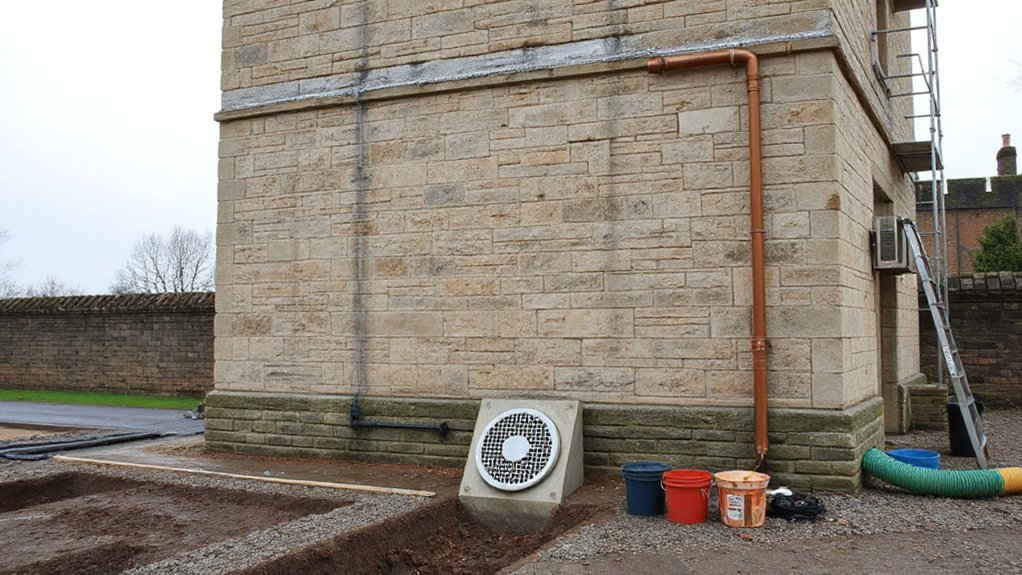
Once you’ve stabilised the masonry, you’ll stop damp properly by managing water at ground and roof level. You’ll grade external ground away from the foundations, keep French drains and gullies clear, and make certain downpipes discharge into sound drains rather than soaking the plinth. You’ll also maintain gutters, check flashings, and keep air bricks and sub-floor vents unobstructed so moisture can evaporate instead of tracking through the stone.
Improve Drainage Around Foundations
Although solid stone walls can cope with a bit of moisture movement, a gatehouse will stay damp if you let rainwater pool at the base of the foundations. You’ll fix it by managing ground levels and directing surface water away without trapping moisture, supporting historic preservation and sensitive garden landscaping choices.
- Regrade external ground to fall at least 1:40 away from walls for 1–2m; keep internal floors higher than external.
- Lower soil or paving to expose a minimum 150mm splash zone beneath the damp line; don’t bury plinths.
- Install a French drain: geotextile, 20–40mm clean gravel, perforated pipe to a soakaway; keep it off footings.
- Use permeable surfaces (gravel, clay pavers on grit) and avoid dense concrete haunching.
Maintain Gutters And Ventilation
When you keep rainwater off the walls and moving freely through the building fabric, most “mysterious” damp in a stone gatehouse disappears fast. Start with Rainwater management: clear gutters twice yearly, after leaf fall and spring; check falls, stop overflows, and fit leaf guards where trees dominate. Replace perished unions, ensure downpipes discharge into gullies, not against plinths, and rod any blocked underground runs. Use cast iron or aluminium profiles that match heritage proportions and avoid splashback.
Then sort airflow. Maintain Ventilation systems by keeping airbricks open, adding discreet hit-and-miss vents to wet rooms, and running humidity-controlled extract fans ducted outdoors. Don’t seal breathable limework with acrylic paints; let the building dry.
Restore Gatehouse Openings: Windows, Doors, Lintels
Before you touch the masonry around them, assess each opening as a structural element and a weathering junction: check the stone jambs for rotation, measure lintel deflection, and trace cracks back to their source rather than repointing over symptoms. For Window restoration, retain sound frames, splice in matching timber, and overhaul pulleys, sash cords, and parting beads; you’ll improve operation without altering sightlines. For door refurbishment, square the leaf, reset hinges, and fit a compressible seal to the stop while keeping traditional ironmongery. Treat lintels pragmatically: clean, expose bearings, and replace failed steel with stainless or a like-for-like stone, bedded on NHL lime.
- Confirm bearings and pack with slate.
- Repair glazing putty with linseed.
- Ventilate thresholds; manage splashback.
- Prime end-grain; paint promptly.
Insulate a Stone-Built Gatehouse Without Trapping Moisture
Because solid stone walls in UK gatehouses rely on vapour permeability and steady heat to stay dry, you need an insulation build-up that slows heat loss without creating a cold, impermeable layer where moisture can condense. Choose breathable internal insulation: woodfibre boards or calcium silicate, bedded in lime plaster, and finish with vapour-open paint. Avoid foil-backed PIR, gypsum dot-and-dab, and cement renders that block drying paths and drive interstitial condensation. Keep junctions continuous at reveals and eaves, but allow controlled ventilation to voids so timbers don’t sweat. Improve floors and roofs with natural fibre quilt plus airtightness tapes, then commission a hygrothermal check (e.g., WUFI) to confirm moisture safety. This approach supports Historic preservation while boosting energy efficiency and comfort year-round.
Run Electrics and Plumbing in a Historic Gatehouse Discreetly
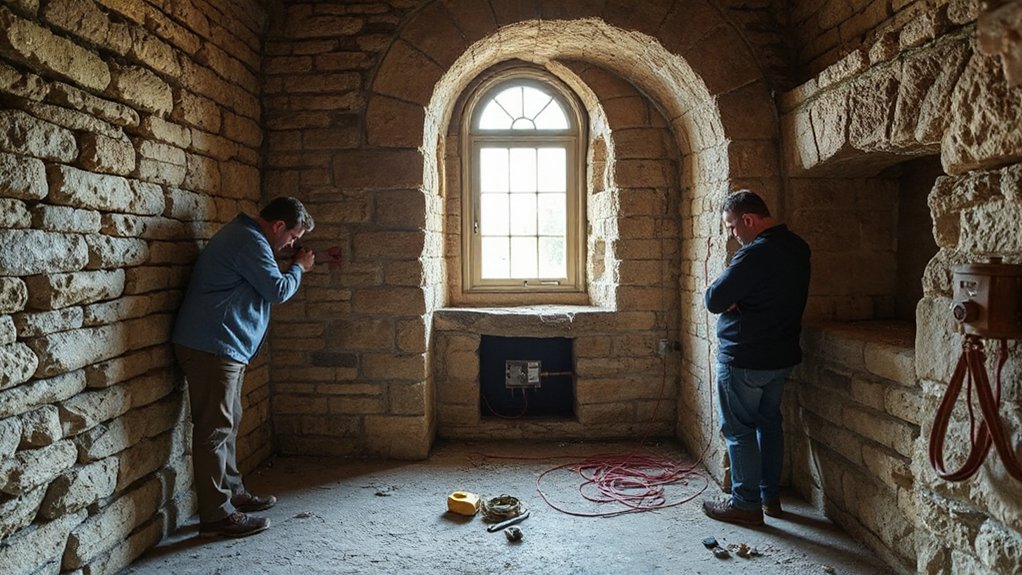
Breathable insulation keeps the stonework warm and able to dry, so you must route services in ways that don’t puncture that layer or chase deep into historic masonry. Treat the gatehouse’s Historical significance as a design constraint: keep interventions reversible, visible for inspection, and confined to new linings, floors, and service voids.
- Use surface-mounted metal conduit in cupboards and corners; fit RCD/RCBO protection at the consumer unit.
- Run cables and data in accessible trunking within stud zones; leave draw wires for future pulls.
- For plumbing, favour PEX in sleeved runs, isolate with service valves, and clip to new joists, not stone.
- Penetrations: core-drill only where essential, sleeve, seal with lime-compatible grommets, and record all works as preservation techniques.
Finish Stone Walls With Breathable Plaster and Paint
Once you’ve stabilised the stonework and allowed it to dry down, finish internal walls with a vapour-open plaster system that lets moisture migrate to the surface rather than trapping it behind gypsum or vinyl paint. Choose lime-based base coats, haired where needed, and key them onto raked joints or a modestly roughened face; avoid bonding agents that reduce permeability. You’ll need scratch, float, then fine finish coats, keeping each thin and well-carbonated, with gentle background warmth and ventilation. Where you want Decorative plaster, specify lime putty with fine aggregates and limit polishing. For paint finishes, use limewash, silicate mineral paint, or breathable clay paint; prime only with compatible mineral primers. Detail around sockets with lime-compatible fillers, and keep skirtings off the floor to prevent capillary bridge.
Frequently Asked Questions
How Much Does Renovating a Stone-Built Gatehouse Typically Cost Overall?
You’ll typically pay £2,000–£4,500/m² overall, often £150k–£450k+ in the UK, depending on condition and heritage constraints. Use cost estimation and budgeting tips: surveys, contingencies 15–25%, VAT, skilled stonemasons.
How Long Does a Full Gatehouse Renovation Usually Take From Start to Finish?
You’ll typically need 9–18 months, like scaffolds rising and schedules beating. You’ll navigate historic preservation consents, structural engineering surveys, tendering, lead times, and UK weather; complex masonry, services upgrades, and defects can push you beyond 24 months.
Can I Live in the Gatehouse While Renovation Work Is Underway?
You can, but you’ll need strict zoning, safe access routes, and temporary services. You’ll coordinate Interior design sequencing and Modern amenities installs, meet CDM duties, control dust/noise, and secure Building Control sign-offs.
What Insurance Cover Do I Need During a Historic Building Renovation?
You’ll need UK specialist renovation/building works cover: buildings, contract works, public/employers’ liability, professional indemnity, and legal expenses, with heritage reinstatement for historic preservation. Confirm unoccupied terms, listed-consent conditions, and robust evidence for insurance claims.
How Do I Find Qualified Contractors Experienced With Historic Stone Buildings?
Like finding a needle in limestone, you’ll source them via RIBA Conservation Register, IHBC directories, and Historic England referrals. Specify Architectural preservation competence, ask for lime-mortar portfolios, method statements, references, and verify Skilled craftsmanship accreditations.
Conclusion
You bring your stone-built gatehouse back like Theseus threading the maze: you survey movement, damp and the roofline, then secure Listed Building Consent before you touch a joint. You repoint and patch with breathable lime, cure defects at source with gutters, falls and vents, and repair openings with minimal loss. You insulate with vapour-open build-ups, route services reversibly, and finish in lime plaster and mineral paint—so the fabric stays dry, sound and authentic.
About the Author