Use Biophilic Design 2.0 by treating nature cues as building-system inputs you can measure and control. Start with source control: remove hidden VOC emitters, specify verified low-VOC materials, and re-test TVOCs in 48–72 hours. Keep CO₂ near outdoor baselines with ASHRAE 62.1 outdoor-air rates and conservative demand-controlled ventilation. Stabilize comfort with daylight/shading controls and 30–50% RH. Add plants for microclimates and attention, then prove gains with IAQ sensors and quick mood check-ins—next you’ll see how to track results over time.
Key Takeaways
- Set measurable IAQ and well-being targets, integrating sensors and controls, and align documentation with WELL, Fitwel, or LEED for verification.
- Remove VOC sources first by specifying low-emitting materials and products, then confirm improvement with baseline and follow-up TVOC measurements.
- Keep CO₂ near outdoor baselines using ASHRAE 62.1 outdoor-air rates and conservative demand-controlled ventilation to reduce drowsiness and discomfort.
- Maintain 30–50% relative humidity with hygrometers, dehumidification/HRVs, and fast leak response to prevent irritation, mold risk, and stress.
- Use plants, circadian lighting, and optimized airflow paths to create comfortable microclimates, then validate mood gains through surveys paired with sensor trends.
What’s New in Biophilic Design 2.0?
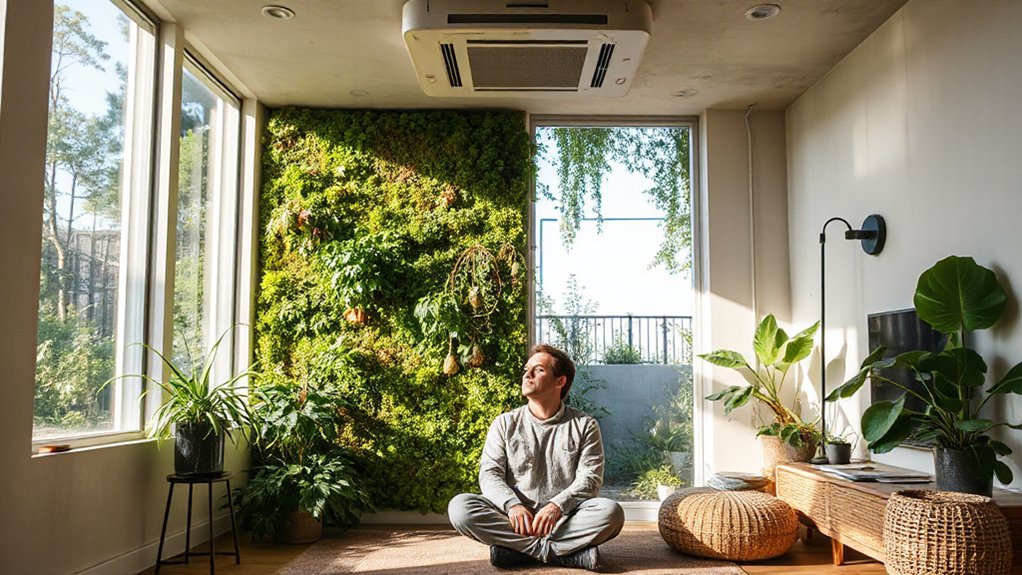
While classic biophilic design focused on adding plants and natural materials, Biophilic Design 2.0 shifts toward measurable performance—especially for indoor air quality and occupant well-being. You move beyond biophilic aesthetics as a finish strategy and treat nature-based cues as building system inputs. You specify sensor-ready ventilation, filtration, and operable façades, then verify outcomes with IAQ monitors and post-occupancy evaluation. You coordinate daylight, glare control, and thermal comfort through integrated controls instead of standalone “green” features. You also design for Urban wildlife by planning bird-safe glazing, pollinator corridors, and habitat-friendly setbacks that meet municipal biodiversity guidance. You document impacts using WELL, Fitwel, or LEED credits, so your design decisions stay auditable, comparable, and scalable across portfolios.
Biophilic Design 2.0 Goals: Air + Mood
Because your occupants can’t feel “biophilia” if the air is stale or the space is stressful, Biophilic Design 2.0 targets two outcomes you can specify and verify: cleaner indoor air and better mood. You’ll treat both as performance metrics, not décor: track particulate levels, ventilation effectiveness, and perceived comfort, then design cues that reduce cognitive load. Evidence links daylight access, views, and coherent biophilic aesthetics to lower stress and better task focus. Pair that with nature inspired textures that support calm without adding maintenance burden.
- Set IAQ targets (PM2.5, CO2) and log them
- Use daylight/glare controls to stabilize circadian cues
- Add high-surface-area greenery where HVAC won’t short-circuit
- Specify acoustic absorption to cut stress reactivity
- Run post-occupancy surveys alongside sensor data quarterly
Stop VOCs First: The Biggest IAQ Win
If you want the fastest IAQ gains, you’ve got to cut VOCs at the source—plants and filters can’t reliably offset ongoing emissions. Start by spotting hidden emitters like paints, sealants, composite wood, flooring adhesives, and fragranced products, then verify with SDS sheets and third-party labels. Specify low- or no-VOC coatings and adhesives, add-emitting-materials-compliant furnishings, and you’ll lower baseline VOC load so your biophilic elements can support both mood and air quality.
Identify Hidden VOC Sources
Hidden VOC sources often drive the biggest indoor air quality problems, so you’ll get the fastest IAQ and mood gains by finding and removing them before adding more “healthy” elements. Start with a walkthrough and a simple IAQ baseline (TVOC/PM2.5, odor log, occupant symptoms). Don’t rely on air filtration alone; it can’t fully capture all gases, and scent masking can hide a continuing source.
- Plug-in air fresheners, scented candles, reed diffusers
- Cleaning sprays, disinfectants, degreasers stored under sinks
- Office equipment zones (printers/toners) with poor exhaust
- Attached garage air leakage (fuel, solvents, lawn chemicals)
- “Off-gassing” storage closets (new textiles, foam, packaged goods)
After removal, verify by re-measuring TVOCs over 48–72 hours and checking that odors don’t rebound.
Choose Low-VOC Materials
Once you’ve removed the obvious and sneaky VOC offenders, your next biggest IAQ win comes from stopping new emissions at the source by choosing low-VOC materials. Specify paints, sealants, adhesives, and composite woods that meet CDPH Standard Method (v1.2) and GREENGUARD Gold; verify documentation, not marketing claims. Favor no-added-formaldehyde MDF/plywood, mineral-based plasters, and waterborne coatings, and require low-emitting flooring systems and underlayments. Ask installers to follow wet-product coverage rates and curing times, then ventilate aggressively during fit-out to reduce peak off-gassing. In biophilic architecture, these specs keep “green” elements from being undermined by chemical loads. Even if you’re adding Urban rooftop gardens, your indoor air won’t improve if interiors keep emitting VOCs.
Lower CO2: Ventilation and Breathing Room
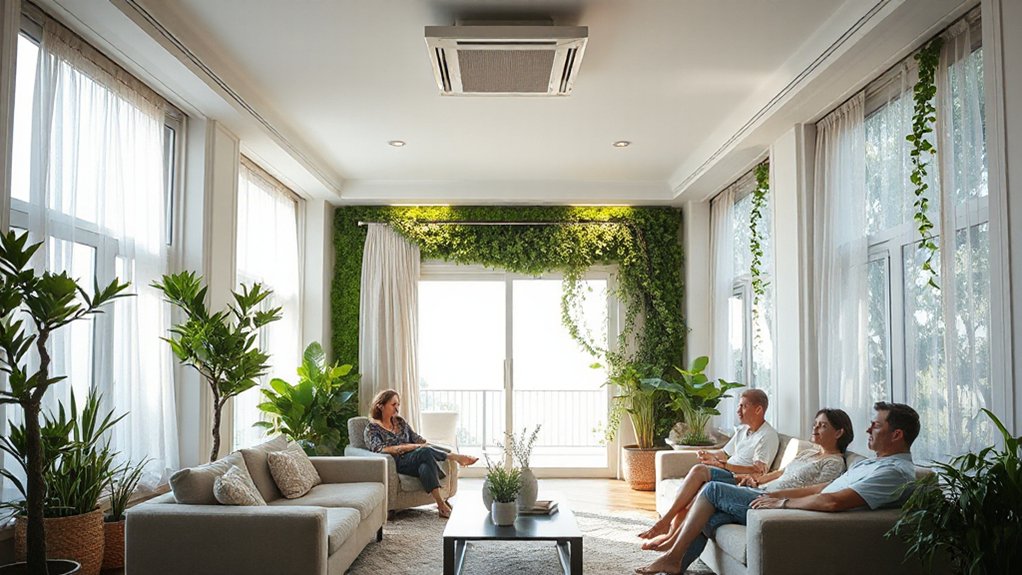
Because humans exhale CO₂ continuously, indoor levels can climb fast in tight, energy-efficient rooms—often tracking straight to how much fresh air you bring in and how crowded the space gets. Keep CO₂ nearer outdoor baselines to protect decision-making and perceived freshness; many facilities target <800–1000 ppm during occupancy.
- Verify outdoor-air rates against ASHRAE 62.1, and commission dampers and sensors
- Use demand-controlled ventilation, but set conservative CO₂ setpoints and minimum airflow
- Improve air circulation with well-placed supply/return paths; avoid dead zones in corners
- Reduce density: add breathing room with layout changes, staggered schedules, or smaller meetings
- Treat Indoor plants as spatial cues for “fresh-air zones,” but rely on mechanical ventilation for CO₂ control
Plants in Biophilic Design 2.0: What They *Can* Do
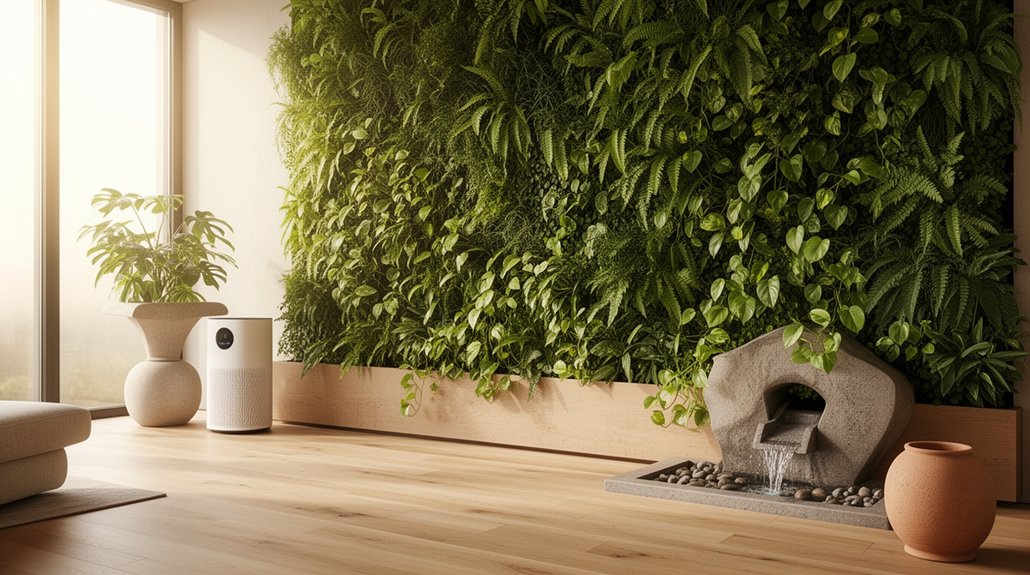
When you add plants to a Biophilic Design 2.0 strategy, you should treat them as targeted supports—not a substitute for ventilation—because real-world VOC uptake is measurable but limited at typical indoor plant densities. You can still use planting to tune humidity and create small comfort microclimates near work zones, especially when you pair species selection with irrigation and maintenance controls. You’ll also see the most reliable gains in mood and attention when you place greenery within the visual field and integrate it with daylight, acoustics, and ergonomics.
Natural VOC Uptake Limits
Although plants can absorb certain VOCs through leaf stomata and root-zone microbes, their real-world uptake in occupied buildings stays modest compared with source control and mechanical ventilation. In urban architecture, you’ll get better IAQ outcomes by treating plants as a supplemental measure, not a compliance strategy. Prioritize low-emitting sustainable materials and verify performance with commissioning and IAQ testing, then use greenery to support perception and comfort.
- Specify low-VOC adhesives, sealants, and furnishings up front
- Maintain designed outdoor air rates and verify with TAB reports
- Use MERV 13+ filtration and change filters on schedule
- Monitor TVOC and formaldehyde, not just CO₂
- Place plants where airflow passes them, but don’t expect big ppm drops
Humidity And Microclimates
To use this intentionally, group plants to create Microclimate zones: cluster planters near workstations, seating, or perimeter glazing where radiant cooling or drafts increase discomfort. Pair them with low-velocity air delivery so moisture isn’t immediately stripped away. Monitor with spot RH sensors at 0.9–1.1 m height, not just at return air. Avoid overwatering; saturated media raises RH and can increase mold risk if surfaces stay cool.
Mood And Attention Effects
Why do a few well-placed plants make a space feel calmer and easier to focus in? You’re tapping a measurable psychophysiological response: visual contact with greenery can reduce perceived stress and support Mood enhancement, which in turn improves attention focus. In workplaces and learning settings, studies link indoor plants to small but consistent gains in self-reported concentration and task persistence, especially in visually monotonous rooms. Treat plants as a low-tech “restorative cue” that complements lighting, acoustics, and ventilation rather than replacing them.
- Place one plant within your primary sightline (1–3 m)
- Use moderate leaf density; avoid clutter that distracts
- Repeat species/forms to create visual coherence
- Pair plants with daylight access for stronger effects
- Maintain health; dying plants can backfire psychologically
Best Plant Setups for Real-World IAQ Support
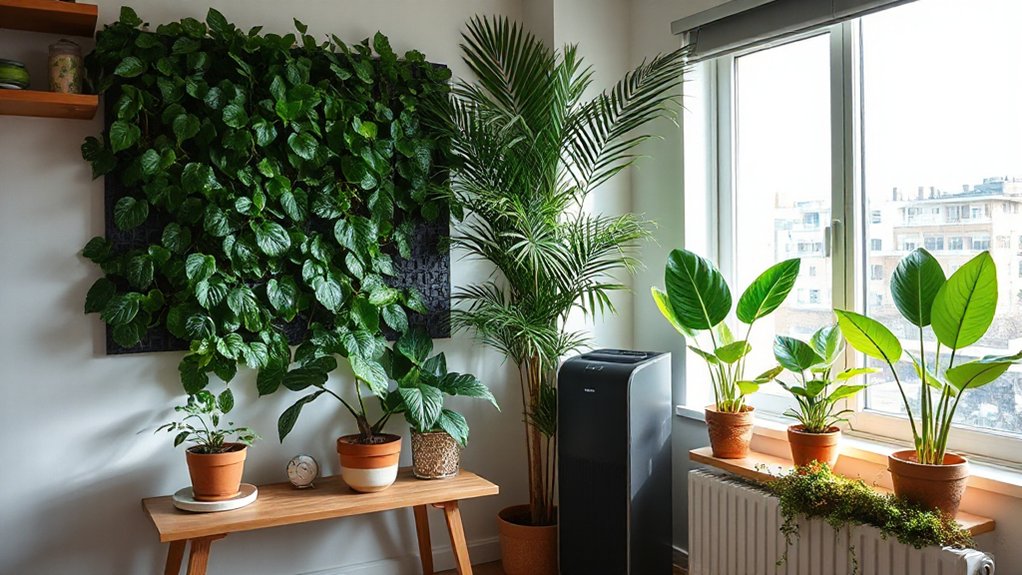
When you treat plants as part of a whole-room IAQ strategy—not a standalone air purifier—you’ll get more reliable results in day-to-day spaces. Aim for coverage, not one “hero” plant: cluster 3–5 medium plants per 100 sq ft in occupied zones, and pair them with mechanical ventilation and MERV-rated filtration.
Use Plant placement to support airflow patterns: keep foliage 2–6 ft from supply diffusers and returns so leaves don’t short-circuit air mixing, and avoid blocking grilles. Prioritize species that tolerate typical indoor RH and light (pothos, snake plant, peace lily) so transpiration stays consistent. For Microclimate optimization, group plants near daylight and away from heat sources; use self-watering planters to prevent wet media and mold-prone conditions. Maintain weekly.
Low-Tox Materials That Support Healthy Microbes
You can support a healthier indoor microbiome by specifying material assemblies that don’t shed persistent biocides or plasticizers, such as solid wood, mineral plasters, ceramic tile, and low-additive wool or cotton. You’ll also protect IAQ by choosing verified low-VOC finishes and sealants (e.g., GREENGUARD Gold– or CDPH v1.2–compliant) and prioritizing water-based, low-odor chemistries. Pair these selections with moisture-smart detailing—because stable humidity and cleanable, breathable surfaces help beneficial microbes persist while limiting mold.
Microbe-Friendly Material Choices
Although plants and ventilation get most of the credit, your material palette largely determines what ends up in your breathing zone—and whether indoor microbes stay balanced or go off the rails. To support a resilient indoor microbiome, specify Microbe friendly materials that don’t shed problematic particles or trap moisture. You’ll also want to be cautious with Antimicrobial surfaces: they can reduce pathogen load in targeted zones, but overuse may suppress beneficial diversity and select for hardier strains. Prioritize cleanable, moisture-stable assemblies and verify ingredients with manufacturer disclosures and third-party certifications.
- Unfinished, sealed-at-mill hardwood or cork flooring
- Mineral-based drywall/gypsum board with simple binders
- Natural linoleum (not vinyl) for high-traffic areas
- Stainless steel only where hygiene protocols demand it
- Washable, tightly woven wool upholstery with removable covers
Low-VOC Finishes And Sealants
Material selection sets the baseline, but finishes and sealants often determine the real chemical load because they sit at the surface and off-gas directly into the breathing zone. For VOC mitigation, specify waterborne, low-odor coatings and adhesives with third-party certifications (e.g., GREENGUARD Gold, CDPH v1.2) and verify SDS for exempt solvents. Use mineral-based paints (silicate, limewash) and hardwax oils where appropriate; they typically emit fewer aldehydes than conventional alkyds. Choose sealants labeled low-VOC and low-isocyanate; avoid high-solvent silicone primers and moisture-cure urethanes in occupied areas. Sequence work so you apply finishes early, then flush with outdoor air and run MERV 13 filtration during cure. You’ll cut peak VOCs and reduce microbial stressors.
Biophilic Design 2.0 Lighting: Daylight + Circadian Plan
When daylight and electric light work as one system, indoor spaces can support your circadian rhythm instead of fighting it. You’ll boost alertness by day and protect melatonin at night using a layered, controllable lighting spec aligned with WELL and IES guidance. Pair it with biophilic aesthetics—natural textures like wood and stone reduce glare and soften contrast.
- Map daylight with simulations, then size shading to prevent afternoon overexposure
- Use tunable-white LEDs: higher CCT and vertical illuminance in mornings, warmer evenings
- Add daylight sensors + dimming drivers so electric light yields automatically
- Specify low-flicker, high-CRI sources to cut eye strain and color distortion
- Control scenes by task and time, not just switches, and commission them properly
Biophilic Design 2.0 Airflow: Layouts That Vent Well
Because air follows paths of least resistance, your floor plan either supports healthy ventilation or creates dead zones that trap CO₂, odors, and fine particles. Map expected Airflow patterns from supply to return, then remove obstacles: keep transfer paths clear, avoid tall storage near diffusers, and use open sightlines between inlets and outlets. Place high-occupancy zones (desks, meeting areas) within the primary throw of supply air, not in corners or behind partitions. Strengthen Ventilation strategies by pairing operable windows or louvers with a defined exhaust point to drive cross-flow, and specify undercut doors or transfer grilles so air can move without pressure buildup. Validate with smoke tests or low-cost CO₂ logging, and adjust diffuser direction, furniture, or zoning accordingly.
Water + Humidity: Stay Comfy, Avoid Mold
Although plants and water features can calm a space, unmanaged moisture quickly degrades indoor air quality by fueling mold growth, dust mites, and VOC-emitting microbial activity. If you use Water therapy elements (fountains, aquariums, misting), treat them like mechanical systems: specify targets, monitor, and maintain. Aim for 30–50% RH; above ~60% increases biological growth risk, while very low RH irritates airways and increases particle resuspension.
- Install a hygrometer and set alerts for humidity control excursions.
- Size dehumidifiers/HRVs to your load, not room size alone.
- Exhaust bathrooms and kitchens to outdoors; verify airflow (CFM).
- Clean reservoirs weekly and prevent stagnation; use splash guards.
- Fix leaks within 24–48 hours; dry assemblies fast to avoid spore blooms.
Nature Patterns That Reduce Stress and Fatigue
If you design for your nervous system—not just your eyes—you can measurably cut stress and mental fatigue with specific biophilic “nature patterns.” Research in environmental psychology and neurophysiology shows that non-threatening natural cues (soft fractals, leaf-like geometry, gentle airflow and sound, and dynamic daylight) reduce sympathetic arousal and restore directed attention, which translates into better mood, fewer headaches, and improved task performance.
Apply this by specifying fractal finishes (0.8–1.3 D) in textiles and wall panels, adding plant-inspired perforations in acoustic baffles, and using circadian-tuned LEDs with daylight-responsive dimming. Build “Wildlife corridors” indoors: continuous sightlines to greenery, repeated natural motifs, and clear wayfinding that prevents visual clutter. Pair break areas with Forest bathing cues—dense planting, natural materials, and shaded refuge—to speed recovery between focused tasks.
Soundscapes: Add Calm Without Noise Clutter
How do you make a space feel calmer without making it louder? You design for sound harmony: replace unpredictable noise with stable, low-level natural cues while prioritizing noise reduction at the source. Building-acoustics research links fewer disruptive peaks and lower reverberation to better perceived comfort and focus. Start by treating the room, then layer a controlled biophilic soundtrack only where it supports the task.
- Specify NRC-rated acoustic ceilings or wall panels to cut reverberation
- Seal door bottoms and use soft-close hardware to stop impulsive clatter
- Add plants plus porous planters to mildly diffuse mid-high frequencies
- Use a dedicated sound-masking track (water, wind) under 45 dBA, steady
- Zone speakers to avoid overlaps and keep consistent coverage
You’ll get calm without noise clutter, and occupants won’t strain to hear.
Sensors + Tracking: Prove IAQ, Sleep, and Mood Gains
Once you’ve stabilized the sound environment, you can validate whether biophilic upgrades actually change human outcomes by measuring what matters: indoor air quality (IAQ) and downstream sleep and mood signals. Deploy calibrated IAQ nodes for CO2, PM2.5, TVOCs, temperature, and RH, and log data at 1–5 minute intervals. Use sensor tracking to baseline two weeks, then compare post-intervention trends while holding HVAC schedules constant. Pair environmental data with wearables or app check-ins for sleep duration, awakenings, and perceived stress. Run simple pre/post analyses: median CO2 during occupied hours, PM2.5 peaks, and nightly sleep efficiency. Add privacy-safe mood analytics (weekly micro-surveys) to detect sustained mood lift, not one-off novelty effects. Report results in dashboards facilities and HR can act on.
Frequently Asked Questions
How Do Biophilic Upgrades Affect Renters Who Can’T Modify Ventilation Systems?
You can still improve comfort and perceived air quality with DIY installation, rental friendly solutions like portable HEPA filters, sealed-planter soil covers, low-VOC materials, and daylight-boosting layouts; studies show these reduce particulates and stress.
What’s the Typical Budget Range for a Biophilic Design 2.0 Refresh?
You’ll typically spend $500–$5,000 for a biophilic refresh: swap finishes, add greenery, tune lighting. Industry projects show Natural materials and smart plant selection drive costs. You’ll pay more for custom millwork, irrigation.
Are Biophilic Elements Safe for People With Pollen, Mold, or Pet Allergies?
Yes, you can use them, but you’ll need Allergy mitigation and allergen safety controls. Choose low-pollen plants, avoid damp soil, maintain HVAC filtration, specify mold-resistant materials, and keep pets out of sensitive zones.
How Long Until You Notice Measurable Mood or Sleep Improvements?
You’ll often notice Mood enhancement in 1–2 weeks, while measurable Sleep improvement typically appears in 2–6 weeks. Track changes with sleep logs, actigraphy, or validated scales. Keep daylight, sound masking, and greenery consistent daily.
Which Biophilic Strategies Work Best in Windowless Offices or Basements?
In windowless offices, you’ll build a “sun” with tunable LEDs for natural light cues, and pair it with smart plant selection—low-light species plus moss walls. You’ll add nature sounds and textured materials.
Conclusion
Biophilic Design 2.0 works when you treat your space like a living lung, not a showroom. You’ll get the biggest IAQ gains by cutting VOC sources, then lowering CO2 with measured ventilation and smarter occupancy. Plants support comfort and perception, but they don’t replace filtration or fresh air. Keep humidity in the safe band to avoid mold. Use acoustic layers and nature patterns to reduce stress. Track it with sensors—you can’t manage what you don’t measure.
About the Author