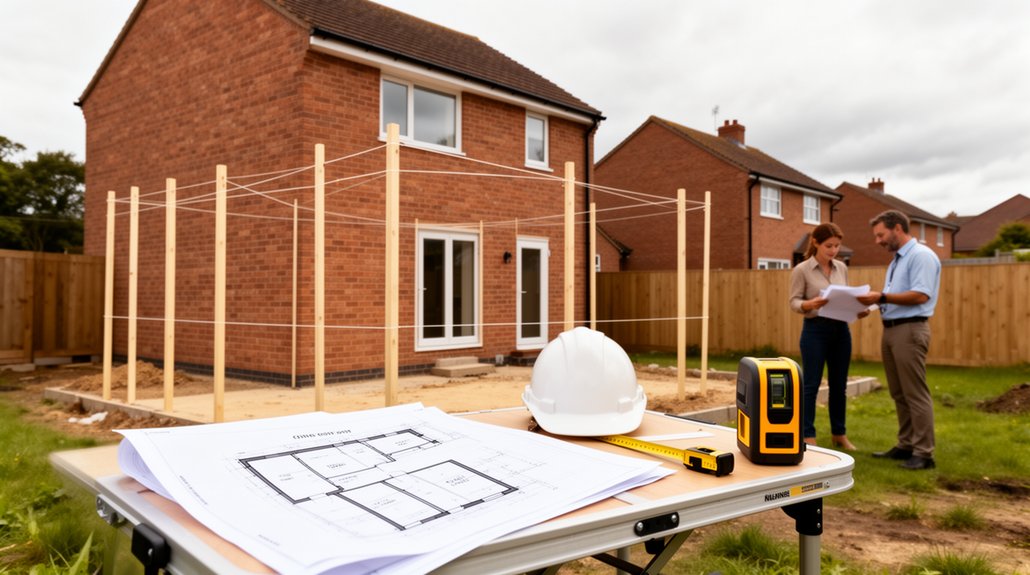
Secure planning permission for a two-storey side extension by first confirming whether it’s Permitted Development (or applying for a Lawful Development Certificate), then checking your council’s side-extension policies on width, subservience, roof form, and boundary gaps. You should map constraints such as Conservation Areas, TPO trees, and restrictive covenants, and verify setbacks and the building line. Design out objections with 45° daylight tests, privacy-safe windows, matching materials, and compliant parking, bins, and cycles—next you’ll see how to package it all for approval.
Key Takeaways
- Check if the proposal qualifies under Permitted Development; if uncertain, apply for a Lawful Development Certificate or full planning permission.
- Review local plan and design guidance on side extensions, focusing on width, setbacks, roof form, materials, and “subservient” massing.
- Confirm site constraints early: Conservation Area status, Tree Preservation Orders, restrictive covenants, and accurate boundaries from a measured survey.
- Design to protect neighbours’ amenity by controlling height and bulk, applying the 45° daylight test, and managing overshadowing and outlook impacts.
- Prevent overlooking with careful window placement, obscure glazing, and restricted openings, clearly shown on drawings, sections, and window schedules.
Work Out if It’s Permitted Development
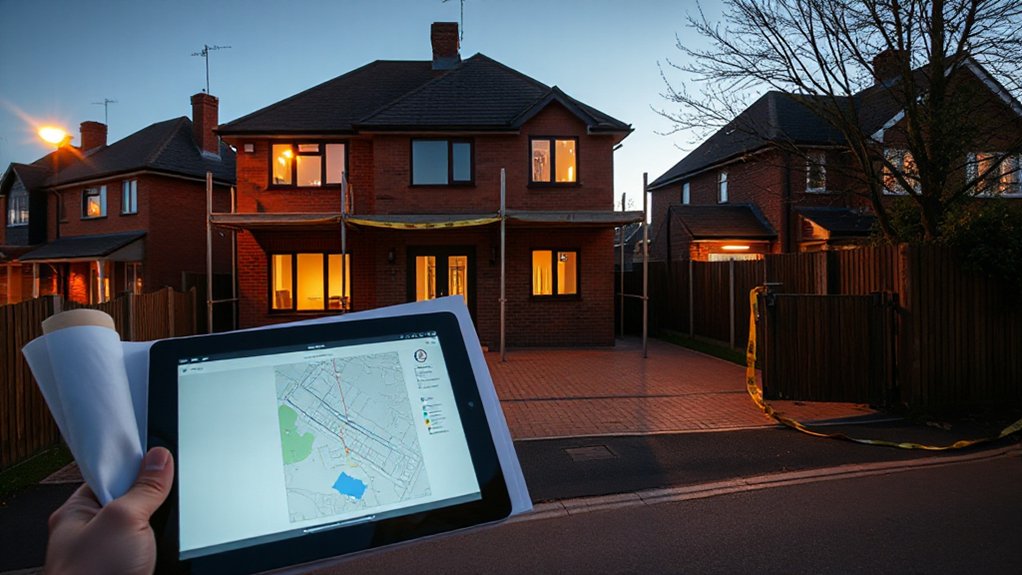
First, check whether your two-storey side extension falls under Permitted Development (PD) rights, because if it does you can usually avoid a full planning application. Confirm the property type qualifies (typically a house, not a flat), and verify PD hasn’t been removed by conditions, an Article 4 Direction, or prior consents.
Measure against PD limits: the extension must be to the side/rear within the “original house” footprint; it can’t exceed half the original house’s width, must use similar external materials, and any upper-floor side windows must be obscure-glazed and non-opening below 1.7m. Keep eaves and ridge within existing heights. Use Design inspiration that respects these constraints and select construction techniques that maintain matching finishes. Apply for a Lawful Development Certificate to evidence compliance.
Check Local Side Extension Planning Policies
Even if your two-storey side extension looks acceptable in principle, you’ll still need to check your council’s Local Plan and any adopted design guidance because these policies often set tighter rules than national guidance on width, massing, roof form, and the required “set-in” from the main front elevation. Start by reading the side-extension or “householder” sections and any Residential Design SPD, then note numeric standards: minimum gaps to boundaries, maximum projection, ridge and eaves alignment, and rules to keep the extension clearly subordinate. Check whether Urban zoning policies require matching materials, window proportions, or minimum parking retention. Look for Historical restrictions embedded in policy, such as protecting street rhythm, characteristic roofscapes, or semi-detached symmetry. Record relevant policy codes; you’ll reference them in your Design and Access Statement.
Find Constraints: Conservation, Trees, Covenants
Next, you’ll confirm whether your property sits in a Conservation Area, because that status can tighten design, materials, and visibility requirements for a two-storey side extension. You’ll also check for Tree Preservation Orders and any trees within the required proximity, since works to protected trees (or roots) can trigger separate consent and constraints on foundations and layout. Finally, you’ll review your title register and deeds for restrictive covenants, because a private covenant can block or condition the extension even if planning permission is granted.
Conservation Area Constraints
- Check the council’s conservation area appraisal and management plan, then align massing, roof form, and setbacks accordingly.
- Expect tighter limits on demolition and external alterations; you’ll often need full planning, not permitted development.
- Specify materials and detailing that match prevailing grain—brick bond, window proportions, eaves, and boundary treatments—supported by a heritage statement.
- Confirm whether Article 4 Directions remove normal freedoms, and show compliance in drawings, streetscape elevations, and a design-and-access statement.
Tree Preservation Orders
Although you can often design around them, Tree Preservation Orders (TPOs) and conservation-area tree controls can stop a two-storey side extension before it starts, so you should identify protected trees early and map their constraints onto your layout. Check the council’s TPO register and conservation maps, then commission an arboricultural survey to BS5837. You’ll need an Arboricultural Impact Assessment and Tree Protection Plan showing canopy spread, Root protection areas, and any required no-dig construction. Keep foundations, drains, and scaffolding outside exclusion zones, and specify permeable surfaces to maintain Tree health. If you must prune or fell, you can’t rely on planning permission alone; submit a separate TPO/conservation notice with justified reasons, method statements, and replanting proposals. Non-compliance risks prosecution.
Restrictive Title Covenants
Before you commit to drawings, check your title deeds for restrictive covenants that limit extensions—these private legal controls can block a two-storey side extension even where planning permission is achievable. Title covenants often bind successors and may be enforced by a developer, neighbour, or management company. You’ll need to identify the benefiting land and the wording, then decide your route:
- Order official copies and review the register and any filed plan.
- Look for limits on height, building line, materials, or “no additional dwelling” clauses.
- Ask a solicitor to assess enforceability, variation options, and indemnity insurance viability.
- If needed, negotiate a deed of release or apply to the Upper Tribunal to modify legal restrictions.
Don’t rely on planning officers; covenants sit outside the planning system.
Check Boundary Rules, Setbacks, and Building Line
Once you’ve confirmed the extension’s broad feasibility, you must lock down the site constraints that most often derail side extensions: boundary rules, required setbacks, and the established building line. Start by verifying your legal boundary on the title plan, then cross-check it on site; where it’s unclear, commission a measured survey to prevent Boundary enforcement issues. Next, review local plan policies and any supplementary guidance for setback regulations, including minimum distances from side boundaries, highways, and visibility splays on corner plots. Map these offsets onto your proposed footprint so you can show compliance on your drawings. Finally, identify the prevailing building line on your street—typically the front wall alignment—and confirm whether infill or projections are controlled. Record your findings, and reference them in your planning statement.
Choose a Compliant Width, Height, and Roof Form
Where do most two-storey side extensions get refused? At the massing stage—when your width, height, and roof form read as overbearing or out of character. You’ll secure approval by aligning with local plan policies on scale, street rhythm, and subordinate design.
- Keep it subservient: Set the ridge and eaves below the main house, and step the front elevation back so it doesn’t dominate.
- Control width: Avoid filling the entire side gap; preserve spacing that supports Design aesthetics and the area’s plot pattern.
- Match roof logic: Use a roof pitch and form that echoes the host building; avoid bulky flat or mismatched hybrids unless policy supports them.
- Prove buildability: Show clean junction details and access scaffolding routes; strong construction logistics reassure officers and neighbours.
Stop Overlooking: Windows, Terraces, Screens
You’ll need to control overlooking by setting side-facing and upper-floor windows where they can’t create direct views into neighbouring habitable rooms or private gardens, and by specifying obscured glazing and restricted openings where required. If you’re proposing a balcony or roof terrace, assume it triggers privacy objections unless you design in compliant screening, suitable setbacks, and carefully managed sightlines. State these measures clearly on your drawings and in your Design and Access/Planning Statement, because planners will condition privacy protection if you don’t.
Window Placement And Privacy
Even if your two-storey side extension meets size and design policies, poorly positioned windows can trigger valid objections and a refusal on privacy grounds. You must demonstrate, on plan and elevation, that new openings won’t create direct overlooking to neighbouring habitable rooms or private gardens, applying your council’s separation-distance guidance and sightline tests. Control both angle and height, and show how you’ll preserve window aesthetics while meeting amenity standards.
- Place side-facing windows to serve non-habitable rooms where possible.
- Use high-level or obscure glazing to any flank elevation within sensitive distances.
- Fix openings (non-opening) below 1.7m internal floor level where required.
- Specify privacy screens only where a compliant window solution can’t be achieved.
Include sections, window schedules, and materials notes to make compliance auditable.
Terraces And Screening Design
Although councils often accept a well-designed two-storey side extension, an elevated terrace, balcony, or roof deck can fail on amenity if it enables direct overlooking, so you must treat screening as a primary design parameter, not an afterthought. Align terraces design with your authority’s privacy distances, and show sightlines to neighbouring habitable rooms and gardens. Keep platforms away from side boundaries where possible, and avoid raised levels that increase intervisibility. Specify screening solutions that are fixed and effective: 1.7–1.8m obscure-glazed side panels, solid parapets, or integrated louvres set to block diagonal views. Don’t rely on removable planters or “future planting.” Detail materials, heights, and maintenance access on elevations and sections so officers can condition them confidently. Include clear boundary ownership notes.
Protect Daylight: 45° Rule and Shadow Checks
Before you finalise the massing of a two-storey side extension, test its impact on neighbouring daylight using the 45° rule and basic shadow checks, because these are common pass/fail indicators in planning assessments. Apply the 45° test from the neighbour’s nearest habitable-room window centreline, in both plan and elevation, to confirm your extension stays outside the notional sight line. Then support it with proportionate Daylight analysis and a clear shadow impact summary, so case officers can follow your method.
- Plot 45° lines on scaled drawings and label window types.
- Check morning/afternoon overshadowing for spring and autumn benchmarks.
- Flag any obstruction to secondary windows or side returns.
- If you fail, reduce height, set back, or chamfer the rear corner.
Match Materials, Detailing, and Street Character
When you align your two-storey side extension’s materials and detailing with the host house and the wider street scene, you remove one of the most common reasons for refusal: harm to character and appearance under local design policies. Demonstrate Material compatibility by matching brick type, bond, mortar colour, and coursing heights, not just “red brick.” Replicate roof pitch, eaves depth, ridge height, and verge detailing, and specify tiles or slates that visually read the same at street level.
Control elevations: copy window proportions, head and cill alignment, and reveal depth, and keep lintels, soldier courses, and bay details consistent. If you must introduce modern elements, justify them against the council’s design guide and show they preserve Street harmony through a coherent, subordinate side addition.
Fix Parking, Access, Bins, and Cycle Storage
You’ll need to prove your two-storey side extension won’t reduce compliant off-street parking or force unsafe on-street manoeuvres, so set out clear bay sizes, turning space, and retained parking provision on your plans. You must also keep access safe by maintaining required visibility splays, unobstructed footway widths, and workable driveway gradients, and you should show how vehicles will enter and exit in forward gear where policy expects it. Finally, you’ve got to provide screened, accessible bin storage and secure cycle parking with step-free routes to the highway, sized and located to meet your council’s standards.
Off-Street Parking Solutions
Although a two-storey side extension can look policy-compliant on paper, planners often refuse it if it compromises off-street parking, safe access, or day-to-day servicing, so you must show—clearly and with dimensions—how cars will still enter, turn, and exit in forward gear where required, how bin presentation and collection will work without dragging bins through the house, and where cycle storage sits without blocking routes or visibility splays.
- Prove retained spaces meet your council’s minimum bay sizes and aren’t narrowed by piers, gates, or overhangs.
- Optimise driveway design with swept-path tracking and a turning head if reversing is restricted.
- Set out Parking alternatives (car port, tandem bay, or shared access agreement) with supporting plans.
- Fix servicing: a bin store on the street side and secure cycle parking with clear manoeuvring space.
Safe Access And Visibility
Even if your two-storey side extension meets spacing and design policies, it won’t pass if it creates unsafe access, weakens visibility splays, or forces awkward parking and servicing movements. You should prove vehicles can enter and exit in forward gear where required, with turning heads or swept-path tracking that matches your likely user vehicle. Keep driveway gradients and widths compliant with local highway guidance, and protect pedestrian sightlines at the crossover. Maintain clear visibility splays at the junction by setting gates, walls, and planting below prescribed heights; choose Landscaping options that don’t mature into obstructions. If you’re adding or relocating access, show dropped-kerb position, footway impacts, and separation from street furniture. Support safety with well-placed Interior lighting to eliminate dark corners without glare.
Bins And Cycle Storage
Highway safety doesn’t stop at the crossover—your application also needs a compliant plan for refuse and cycle storage so day-to-day servicing doesn’t block the footway, reduce parking capacity, or force bins and bikes into visibility splays. Show collection-day movements and storage locations on your site plan, and tie them to your garden layout so they’re convenient yet screened.
- Provide bin stores sized for your council’s container types, with level access and doors opening away from the highway.
- Keep drag distances short and avoid routes over steps, gravel, or steep gradients.
- Specify secure, covered cycle parking with Sheffield stands and clear access without encroaching on parking bays.
- Add exterior lighting to routes and stores, avoiding glare onto the carriageway and neighbours.
Prepare the Required Planning Drawings and Reports
Before you submit your application, you’ll need a set of accurate planning drawings and supporting reports that demonstrate compliance with local policy and national guidance. Provide location and block plans, existing/proposed floor plans, elevations, and roof plans at recognised scales, with a north point and clear dimensions. Add a site plan showing boundaries, neighbouring buildings, and visibility of the two-storey massing. Your elevations must evidence Design aesthetics and Material selection, specifying facing brick, render, tiles, window frames, and matching detailing to the host dwelling. Include sections where levels change to prove eaves, ridge, and set-backs comply. Submit a drainage strategy if you alter impermeable area, plus an arboricultural report where trees are affected, and heritage documents if the site is constrained. Confirm consistency across every sheet.
Write a Planning Statement to Pre-Empt Objections
Although your drawings show what you’re building, a well-structured Planning Statement explains why it complies with the development plan and the NPPF, and it tackles likely objections head-on. You should cross-reference relevant Local Plan policies, SPD guidance, and any character appraisal, then translate them into clear, testable commitments.
- Principle of development: confirm use, scale, and street scene fit, citing policy wording.
- Design and character: justify massing, roof form, setbacks, and Design aesthetics with elevations and context.
- Amenity impacts: address overlooking, daylight/sunlight, and overbearing effects using measured separation distances and angles.
- Materials: specify matching or complementary finishes, demonstrating Material durability and long-term maintenance.
Conclude with a compliance table so officers can verify each policy point quickly and consistently.
Submit, Respond Fast, and Revise With Confidence
Once you’ve validated your application on the Planning Portal, you need to treat the consultation period like a live compliance exercise: submit every required plan, form, and certificate in the correct scale and format, then monitor the case officer’s requests and neighbour comments daily so you can respond within the stated deadlines. Log every query, answer in writing, and upload revised drawings with clear revision clouds and dates. If the officer flags overlooking, daylight loss, or street-scene harm, you should propose proportionate changes fast: set-backs, hipped roofs, obscure glazing, or reduced ridge height. Keep Design inspiration aligned to the local character appraisal and the council’s design guide. Confirm construction techniques match the submitted details—materials, drainage, and boundary treatment—so conditions stay dischargeable. Ask for pre-decision amendments, not withdrawals.
Frequently Asked Questions
How Long Does a Two-Storey Side Extension Planning Decision Usually Take?
You’ll usually get a planning decision in 8 weeks; major or complex cases can take 13. You’ll speed it up by submitting complete Design considerations, and showing Building regulations compliance, with accurate drawings and reports.
What Are Typical Planning Application Fees for a Two-Storey Side Extension?
You’ll feel like you’re handing over a fortune, but you typically pay £258 in England for a householder application, plus portal/admin fees. Factor Design considerations and Building regulations drawings, surveys, and consultants—often £1,000–£5,000+.
Do I Need My Neighbour’s Written Consent Before Applying for Planning Permission?
You don’t need your neighbour’s written consent before you apply; planning law doesn’t impose consent requirements. However, you should seek neighbour approval early, and you must serve Party Wall notices if you’ll affect shared boundaries.
Can I Start Groundwork Before Planning Approval Is Granted?
You shouldn’t start groundwork before planning approval; you risk enforcement and costly removal. Confirm Building permits first, then schedule Construction timelines. Only undertake surveys or non-material prep, and comply with conditions and neighbour rights.
What Happens if I Build the Extension Without Planning Permission?
Up to 90% of unauthorised builds trigger enforcement: you risk stop notices, forced alterations, or demolition if you build without permission. You’ll still need Building regulations compliance, and poor Extension aesthetics can worsen refusal.
Conclusion
If you’ve done your homework, a two-storey side extension won’t be a planning “adventure.” You’ll have confirmed whether Permitted Development applies, checked local policies, and uncovered any conservation, tree, or covenant “surprises.” By respecting boundary offsets, the building line, and a compliant width, height, and roof form, you reduce neighbour “noise.” Sort parking, access, bins, and cycles, then submit robust drawings and a clear planning statement. Reply promptly and tweak calmly.
About the Author