Start by measuring your slope and mapping runoff during a storm, since a 1-inch rain can dump hundreds of gallons off hard surfaces. Route roof and driveway water with 6–10 ft downspout extensions, rigid pipe, cleanouts, and pop-up emitters to a safe outlet. Then terrace the yard into 2–4 level “rooms” pitched 1–2% away from structures, using walls that match your home. Stabilize soil with deep-rooted plants, mulch, edging, and add warm LED step lighting; keep going for key layouts and pitfalls.
Key Takeaways
- Fix drainage first: redirect downspouts, add swales or drains, and prevent runoff erosion to protect foundations and landscaping.
- Create usable terraces or split-level zones sized for outdoor living, with consistent steps and 1–2% grading away from structures.
- Choose cohesive, durable hardscape materials and code-compliant safety details like uniform risers, slip-resistant surfaces, and handrails where needed.
- Plant erosion-control, low-maintenance vegetation—deep-rooted grasses, shrubs, and groundcovers—mulched 2–3 inches and spaced to knit soil quickly.
- Add warm, layered lighting on steps and paths to boost safety, curb appeal, and nighttime visibility for showings.
Check Your Slope, Soil, and Water Flow
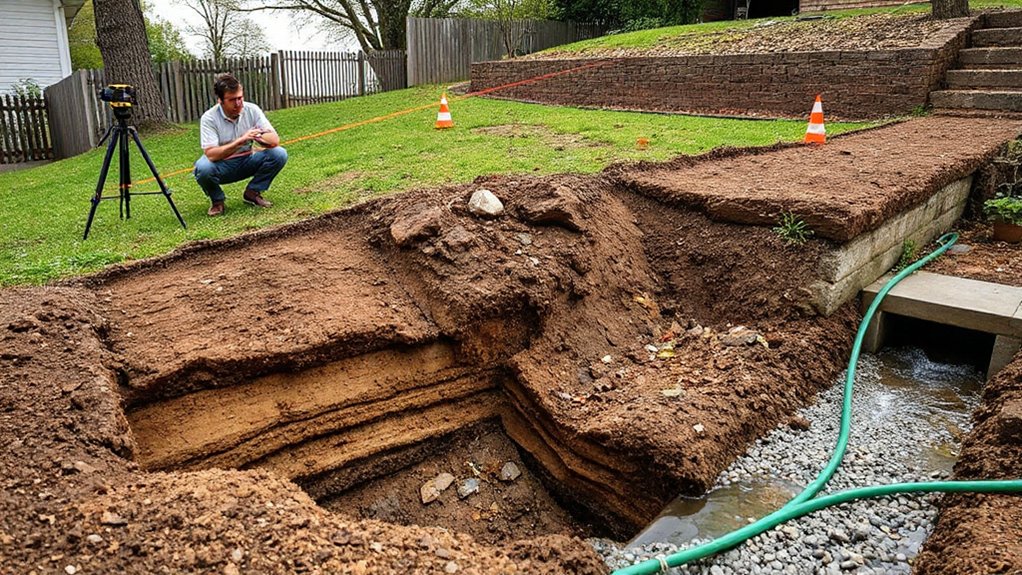
Before you buy plants or book a contractor, measure your slope, test your soil, and map how water moves across the site—because these three data points determine what will survive, what will erode, and what will need drainage. Use a simple level and tape to calculate grade; anything above ~10% usually needs terraces, steps, or retaining solutions to prevent slippage. Run Soil testing for pH, texture, and compaction so you don’t waste money on the wrong amendments or plants; keep results for contractor bids and buyer confidence. For water management, trace runoff paths during a storm or with a hose, then note low spots, downspout outlets, and saturated seams. These notes guide drains, swales, and erosion control placements.
Set Goals: Curb Appeal, Use, and Budget ROI
Next, you’ll set clear goals for your sloping garden by ranking curb appeal upgrades that buyers notice first—clean lines, stable terraces, and low-maintenance planting. Then you’ll define how you’ll actually use the space (seating, play, access, drainage control) so every feature earns its footprint on the slope. Finally, you’ll set a budget with ROI in mind, prioritizing safety and erosion control first and reserving nicer finishes for the areas that influence resale most.
Prioritize Curb Appeal
Although a sloping yard can feel like a constraint, it can boost perceived home value and buyer interest when you set clear goals for curb appeal, daily use, and budget ROI. Start by viewing your front slope like a listing photo: buyers scan lines, symmetry, and maintenance signals in seconds. Create a clean visual “spine” with a terraced edge, crisp path, or stepped planting bands that read from the street. Use seasonal planting to keep color in peak showing months; repeat two to three hardy species for a cohesive look and lower upkeep. Add one focal point of garden art at a sightline break to guide the eye uphill. Prioritize lighting on steps and key plants to improve safety cues and nighttime appeal. Keep mulch lines sharp.
Define Use And ROI
Because a sloping garden can consume labor and cash faster than a flat yard, you’ll get a better outcome by setting three measurable targets upfront: curb appeal (what reads in 5–10 seconds from the street), daily use (how many people will sit, walk, or play there each week), and budget ROI (what upgrades you’ll likely recoup at resale). For curb appeal, pick one focal move: a clean retaining edge, a straight stair run, or layered planting for strong garden aesthetics. For use, map circulation: 36–48 inches for paths, one level pad for a bench or grill, and safe lighting on steps. For ROI, fund “infrastructure first” (drainage, grading, hardscape) before exotic plants. Buyers pay for stability and low maintenance; your landscape design should prove it.
Choose a Slope Layout: Terrace, Split-Level, or Path-Led
Before you commit to plants or hardscape materials, pick a slope layout that matches your gradient, budget, and how you’ll actually use the space. On mild slopes (about 5–10%), a path-led plan with broad steps and landings controls drainage and feels low-maintenance to buyers. On moderate slopes (10–25%), a split-level layout creates distinct zones without heavy retaining work, often cutting labor and permitting risk versus more intensive builds. On steep grades (25%+), you’ll need engineering input; choose the simplest circulation that meets code and safety expectations. Keep sightlines open so the yard photographs well, and place focal points like Garden art at natural pauses. Add edge planting that doubles as wildlife habitats to signal eco value without looking messy.
Terrace the Slope Into Flat Outdoor “Rooms
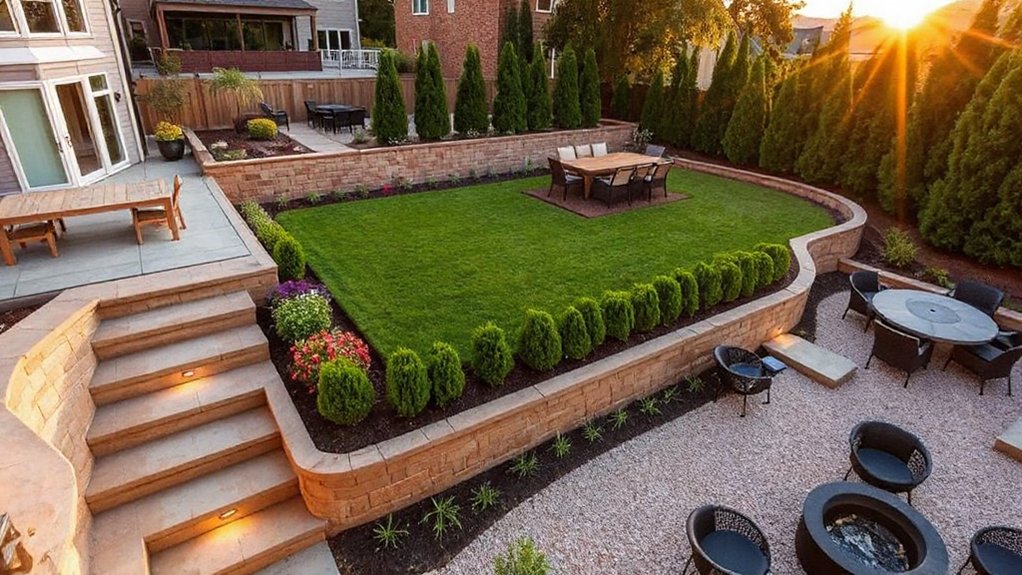
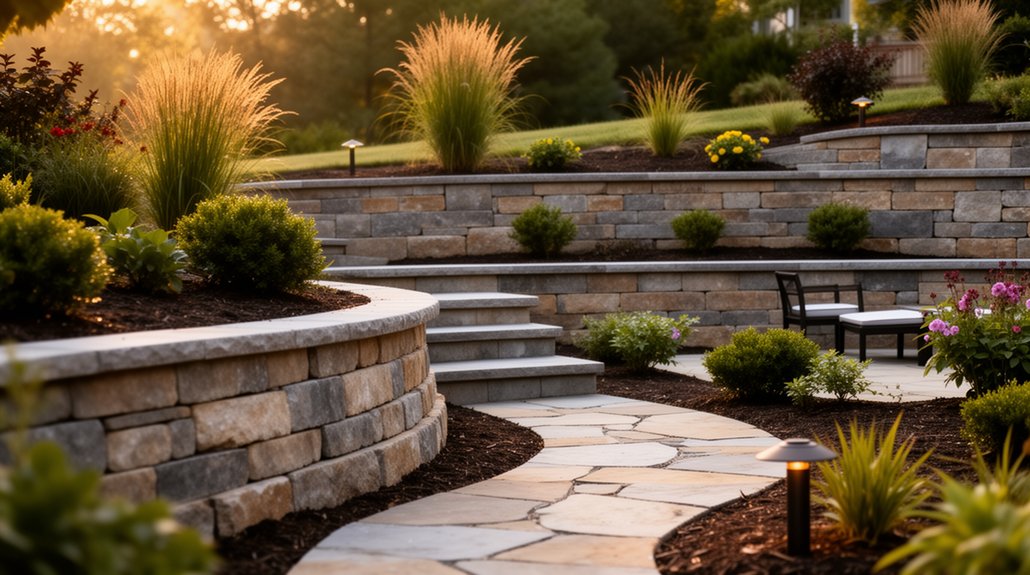
When you terrace a slope into flat “rooms,” you turn awkward grade into usable square footage buyers can measure: dining pad, lounge zone, play area, or vegetable beds. Aim for 2–4 tiers; each platform should be at least 10×10 feet so it stages well with garden furniture and reads as a true destination. Keep step runs consistent and wide enough for carrying trays, strollers, or tools.
Make drainage non-negotiable: pitch each terrace 1–2% away from structures and add gravel-backed drains where water concentrates. Use compacted base and edged surfaces to prevent settling that creates trip hazards. Finally, install outdoor lighting on steps and landings; illuminated circulation tests well in evening showings and boosts perceived safety, extending usable hours.
Pick Retaining Walls That Match Your Home
Although any retaining wall can hold back soil, the ones that match your home’s architecture and materials sell the slope as intentional design: appraisers and buyers read cohesive hardscaping as a higher-quality, lower-maintenance upgrade, not a patchwork fix. If your house is brick, choose brick or brick-faced block; if it’s stone, echo that stone’s color and joint style. Keep capstones, wall height, and curves consistent across terraces so the yard photographs as one project, which helps listings convert faster. Use neutral tones to widen buyer appeal and avoid dated textures. Plan lighting and irrigation sleeves now so you don’t retrofit later. Finish with restrained Garden art that aligns with the wall material, and frame each tier with Seasonal planting for year-round curb impact.
Build Safe Steps and Paths (Grade, Grip, Width)
Matching retaining walls sets the visual standard, but buyers judge a sloping yard just as quickly by how safely they can move through it. Build steps and paths to feel “code-close” and confidence-inspiring, because safety upgrades consistently rank among top ROI exterior fixes. Keep step risers consistent and aim for a comfortable grade on paths so strollers and older buyers won’t hesitate. Use slip-resistant finishes and clear edges to cut perceived risk, especially in shade.
- Keep paths 36–48 inches wide so two people can pass, even near garden furniture.
- Add grip: broom-finished concrete, textured pavers, or stone with rough cleft faces.
- Light it: low-glare decorative lighting at risers and turns improves usability and night appeal.
Finish with sturdy handrails where needed, not fussy.
Fix Drainage: Swales, Drains, and Downspouts
On a sloping garden, you’ll cut erosion and protect hardscape value by moving runoff fast and predictably. You place and size swales to intercept flow at key contours, then back them up with French drains and catch basins where water concentrates. You finish by extending downspouts to tested outlets so roof water doesn’t overwhelm beds, paths, or foundations.
Swale Placement And Sizing
When runoff cuts ruts across a slope or pools near your foundation, you can fix it fast by placing a swale on contour to intercept water before it accelerates downhill. Start with slope analysis: measure grade over 10–20 feet; a 2–8% slope typically benefits most from shallow, broad swales that slow flow without looking like a ditch. For market appeal, keep lines smooth, tie into existing beds, and hide the berm with plantings.
- Set the swale’s centerline level on contour; a 1–2% fall only if you must direct water safely.
- Size for storms: 6–12 inches deep and 18–36 inches wide handles many yards’ runoff.
- Place it upslope of patios and foundations, 10+ feet away, and route overflow to a safe, visible outlet.
French Drains And Catch Basins
If a swale can’t intercept water cleanly—or you need to move it through tight side yards—French drains and catch basins give you a controlled, sellable solution that keeps lawns usable and foundations dry. Install a 4-inch perforated pipe in washed gravel, wrapped in geotextile, and keep 1% slope so water actually moves. Place catch basins at low points, hardscape edges, and driveway runoff zones where sheet flow concentrates; a single basin can intercept hundreds of gallons during a 1-inch storm on a 1,000-sq-ft surface. Tie lines to daylight on your downhill side or an approved discharge point, and add cleanouts for maintenance. Buyers notice dry turf, fewer muddy ruts, and reduced seepage staining, which protects appraisal confidence and inspection results.
Downspout Extensions And Outlets
French drains and catch basins handle runoff once it hits the ground, but you’ll often get bigger wins by controlling roof water before it ever reaches your slope. On a 2,000 sq ft roof, 1 inch of rain sheds about 1,250 gallons—enough to carve rills, undermine steps, and trigger buyer red flags. Install Downspout extensions to move discharge 6–10 feet away, then route it to a safe, visible termination that won’t saturate the hillside. Prioritize Outlet placement that protects foundations, fences, and hardscapes while keeping water off neighbors’ lots.
- Use rigid pipe over corrugated for fewer clogs and longer life
- Add a pop-up emitter at the outlet to prevent erosion
- Tie outlets into a swale or dry well where soil percolates fastest
Prevent Erosion With Plants, Mulch, and Edging
Although a sloped garden can shed water fast, you can cut soil loss dramatically by combining deep-rooted plants, a 2–3 inch layer of mulch, and tight edging that slows runoff and traps sediment. For Plant selection, prioritize fibrous-root grasses, groundcovers, and shrubs placed in staggered rows across the slope; they act like living rebar and reduce splash erosion where buyers notice bare patches most. Use Mulch techniques that stay put: shredded bark or wood chips knit together better than fine compost, and you should top up annually after heavy storms. Install steel, stone, or bender-board edging on contour to create mini check dams, directing sediment into planting beds instead of onto walkways. This keeps the yard cleaner, protects hardscape, and signals low-risk drainage to appraisers.
Use Low-Maintenance Plants for Hillside Stability
On a slope, you’ll get the best ROI by choosing drought-tolerant groundcovers that spread fast and cut irrigation demand. You should pair them with deep-rooted, erosion-control plants that lock soil in place and reduce washouts after heavy rain. Finish with a mulch layer to suppress weeds, protect roots, and lower ongoing maintenance costs.
Drought-Tolerant Groundcover Choices
When you’re trying to stabilize a sloping garden without driving up irrigation and upkeep costs, drought-tolerant groundcovers give you the best return: they knit soil together with dense roots, cut runoff, and suppress weeds once established. For resale, buyers notice uniform coverage and lower water bills, so choose Drought resistant Groundcover options that stay tidy with minimal trimming and don’t require rich soil. Aim for species that spread predictably and won’t invade beds or hardscape.
- Creeping thyme: traffic-tolerant, fragrant, and typically needs 30–50% less water than turf after establishment.
- Sedum varieties: fast coverage, high heat tolerance, and strong color contrast for curb appeal.
- Native low growers: better survival rates in local conditions, reducing replacement costs.
Mulch between plugs early to speed fill-in and reduce erosion.`
Deep-Rooted Erosion Control
Drought-tolerant groundcovers handle surface coverage, but steep slopes stay more stable long-term if you back them up with deep-rooted, low-maintenance plants that “stitch” the soil profile together. Choose natives and structural shrubs with deep roots—think switchgrass, little bluestem, redtwig dogwood, or manzanita—so rainfall can’t shear off saturated topsoil as easily.
Plant in staggered rows on contour, spacing 18–36 inches to create overlapping root zones within 1–2 growing seasons. Prioritize fibrous-rooted grasses for quick knit-up, then add woody plants for long-term holding power. You’ll cut runoff, reduce repair calls, and show buyers measurable durability: fewer bare patches after storms and less soil movement year over year. That’s erosion prevention that sells.
Mulch And Weed Suppression
Because bare soil on a slope can lose several times more sediment than covered ground after a heavy rain, you’ll get faster stability (and fewer callbacks) by pairing low-maintenance, weed-suppressing plants with the right mulch. Pick groundcovers that knit soil (creeping juniper, sedum, liriope) and plant in staggered triangles to close canopy fast. Then lock moisture and reduce splash with 2–3 inches of shredded bark or wood chips; avoid gravel that can migrate downhill. These Mulch benefits translate to cleaner beds, fewer weeds, and higher perceived upkeep value at resale.
- Install biodegradable weed barrier only on bare gaps, not under shrubs
- Edge beds to stop mulch drift and keep paths crisp
- Top-dress annually, focusing on thin spots for consistent weed suppression
Light Each Level for Safety and Night Curb Appeal
Although a sloping garden looks dramatic in daylight, it can turn into a liability after dark if you don’t light each terrace, step, and landing. Smart lighting design reduces trip risk and signals care to buyers who tour at dusk. Aim for consistent illumination on passages: step lights on every riser run, low bollards along paths, and shielded downlights at landings to cut glare.
Treat lighting as visible safety features, not décor. Use warm 2700–3000K LEDs for curb appeal and accurate color on stone and plants. Space fixtures to avoid dark gaps; a simple rule is overlapping beams so no tread disappears in shadow. Add motion sensors on side access routes to boost perceived security while keeping energy use low. Buyers notice the difference immediately.
Avoid Costly Mistakes (Permits, Failures, Upkeep)
Before you cut into a slope or stack the first block, confirm what your local codes require—permits, setback rules, drainage standards, and maximum wall heights—since unpermitted retaining walls and stairs can trigger stop-work orders, forced removal, and appraisal red flags at sale time. In many markets, buyers discount properties with “DIY” walls because failures can cost $50–$150 per square foot to rebuild. Engineer drainage first: hydrostatic pressure is the top cause of wall blowouts. Then budget upkeep; neglected slopes look risky and reduce offers.
- Verify permits pitfalls: survey lines, wall height thresholds, and inspections
- Prevent failures: geogrid, compacted base, weep holes, and outlet drains
- Avoid maintenance mistakes: mulch migration control, stair tread checks, and annual drainage cleanouts
Document everything for buyer confidence.
Frequently Asked Questions
Will Landscaping a Slope Increase My Home Appraisal or Just Buyer Interest?
Landscaping a slope can boost appraisal and buyer interest, but appraisers credit documented, durable improvements. You’ll win more offers with Privacy screening, drainage, and a Roof garden, and you’ll justify comps with receipts.
How Long Does a Full Sloped-Yard Makeover Typically Take to Complete?
You’ll typically need 2–6 weeks for a full sloped-yard makeover, depending on grading, permits, and access. Plan 3–7 days for erosion control, and 1–2 weeks for native planting establishment and irrigation.
Should I Hire a Landscape Architect or Is a Contractor Enough?
Like building on a hillside, you’ll hire a landscape architect for complex grading, drainage, or permits; otherwise, a contractor’s enough. Architects optimize plant selection and garden lighting, boosting curb appeal and ROI by reducing errors and change orders.
What Slope Landscaping Features Offer the Best ROI for Resale Value?
You’ll get best ROI from rock retaining walls that create flat, usable terraces, plus low-maintenance native plants for curb appeal. Add safe steps, drainage, and lighting—buyers pay more for function; you’ll reduce erosion risk.
How Does Sloped-Yard Landscaping Affect Home Insurance and Liability Risk?
Sloped-yard landscaping can lower premiums and claims when you add Erosion control, but it can raise liability if paths and walls fail—like dominoes. Insurers favor drainage, barriers, lighting, and maintained Wildlife habitat.
Conclusion
When you treat your slope like an asset, you boost safety, usability, and buyer appeal. Check drainage, then commit to terraces or a path-led layout, backed by matching retaining walls, erosion control, and low-maintenance plantings. Light each level so showings feel secure after dusk. Example: you cut a 25-foot hillside into two 10×20 patios with a stone wall, drip irrigation, and junipers—your agent markets “three outdoor living zones,” supporting stronger offers.
About the Author