Solar control glass lets you use the big south- or west-facing glazing modern UK extensions want without overheating, glare, or rapid fading of floors and furnishings. Low‑E solar coatings reject infrared heat while keeping strong daylight, so your space stays bright, comfortable, and Part L/Part O friendly. You’ll specify by g‑value, LT and whole‑window U‑value, typically targeting 0.25–0.35 for roof glazing and 0.35–0.45 for façades. Next, see what else to pair it with.
Key Takeaways
- Solar control glass cuts overheating in large south- and west-facing glazing, keeping extensions comfortable without relying on constant blinds or cooling.
- It balances daylight with reduced solar gain by rejecting infrared heat while maintaining high visible light for bright interiors.
- It reduces glare and reflections on screens, improving comfort in open-plan living and home-office areas.
- It helps protect interiors from UV-related fading, extending the life of floors, furniture, fabrics, and artwork.
- It supports Part L/Part O performance targets by optimising g-value and U-value without darkening elevations or compromising modern aesthetics.
Do You Need Solar Control Glass for an Extension?
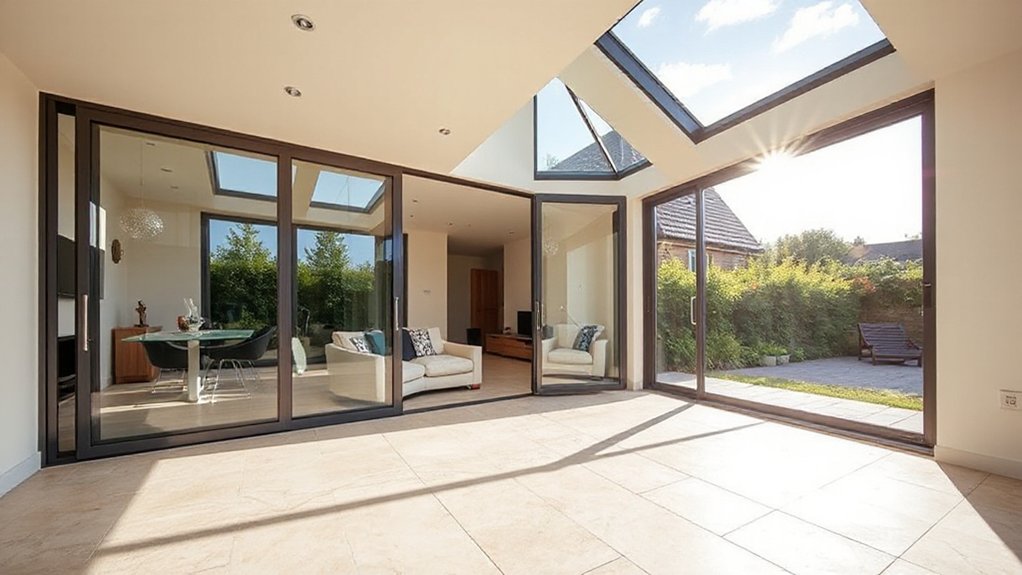
If your extension introduces large areas of glazing—especially south- or west-facing—solar control glass can be the difference between a bright, usable room and a space that overheats. You’ll typically specify it for rooflights, lanterns, sliding doors, or curtain walling where direct sun is unavoidable and shading devices compromise views.
In the UK, you should weigh orientation, glazing ratio, and how you’ll ventilate. If you’re targeting Part L compliance with slim frames and high light transmission, solar control coatings help you balance g-values without darkening the elevation, protecting architectural aesthetics. You’ll also benefit when you want consistent internal finishes, stable seal performance, and reduced stress on units, supporting material durability. Choose a spec that suits your frame system and any planning-led appearance constraints too.
What Problems Does Solar Control Glass Prevent?
Solar control glass helps you control glare in a south-facing extension, so you’re not squinting across a glazed roof or wide sliders during peak sun. By cutting transmitted light and UV, you reduce eye strain and keep task lighting and screen use comfortable without compromising the architectural intent. You’ll also limit fading to upholstery, timber floors, painted joinery, and other interior finishes common in UK open-plan schemes.
Glare And Eye Strain
While expansive glazing can transform a rear extension into a light-filled living zone, it can also introduce harsh glare that washes out finishes, creates screen reflections, and forces you to squint throughout the day. Solar control glass cuts peak luminance and balances daylight, so you keep Eye comfort and Visual clarity without resorting to blinds that compromise the architecture. In UK south- and west-facing elevations, it helps you manage low-angle sun and sky glare across open-plan kitchens, snug corners, and home-working zones. You’ll notice:
- reduced veiling glare on polished worktops and floor tiles
- fewer monitor reflections in garden-room offices
- steadier contrast between bright glazing and darker interiors
- less fatigue during winter sun and summer high glare
- improved wayfinding and safer movement near thresholds and steps
Fabric And Finish Fading
Even when a rear extension feels thermally comfortable, high levels of UV and short‑wavelength light passing through large panes can steadily bleach fabrics and degrade interior finishes. You’ll notice curtains paling at the leading edge, timber floors patching near sliders, and artwork losing contrast under rooflights. Solar control glass reduces UV transmission and moderates the high‑energy spectrum without forcing you into heavy blinds, so your daylighting strategy stays intact.
That improves Fabric durability across upholstery, rugs, and acoustics, and cuts the cycle of replacement in family spaces. It also supports Finish maintenance: varnishes yellow more slowly, painted joinery stays truer, and laminated surfaces resist premature crazing. Specify to BS EN standards and check g‑value, LT, and UV cut for consistent performance year‑round.
How Does Solar Control Glass Work?
You manage solar gain by specifying glass that selectively filters the solar spectrum, rejecting a high proportion of infrared while preserving useful daylight for your extension. You’ll typically rely on microscopically thin Low‑E coatings that reflect heat energy back where you want it, supporting Part L performance targets without over-darkening the space. You can also add controlled tints to cut glare and fine-tune colour neutrality, so your elevations read cleanly in the UK’s mixed light conditions.
Selective Solar Spectrum Filtering
Because sunlight carries energy across a broad spectrum, solar control glass works by selectively filtering those wavelengths to suit your extension’s design brief. You tune Spectral filtering to curb infrared heat gain while maintaining useful daylight, so your kitchen-diner stays bright without overheating on south-facing UK plots. By balancing visible light transmittance against total solar energy transmission, you support Energy efficiency and reduce reliance on mechanical cooling, helping meet Part L intent without compromising architectural clarity. Specify performance values, not marketing labels, and align them with orientation, shading, and frame sightlines. In practice, you’ll evaluate:
- G-value (solar factor) for summer comfort
- VLT for daylight and glare control
- Colour rendering for interior finishes
- External reflectance for planning sensitivities
- Winter solar admission to offset heating loads
Low-E Coatings And Tints
A low‑E coating and a subtle tint give solar control glass its “thermostat” effect by manipulating radiative heat flow without sacrificing clean sightlines. Low e coatings use microscopically thin metallic layers to reflect long‑wave infrared back indoors in winter, while limiting inward solar gain in summer. You keep the daylight you’ve designed for, but reduce glare and hot spots across open‑plan kitchen diners and garden rooms.
Tinted glass works by absorbing and re‑radiating a portion of solar energy, lowering g‑value and helping meet Part L targets without over‑specifying shading. You’ll specify neutral greys or soft bronze for contemporary UK extensions, keeping colour rendering accurate against brick, render, and aluminium frames. Pair the coating with warm‑edge spacers and argon to tighten U‑values and comfort.
Which Specs Matter: G-Value, LT, U-Value?
When you’re specifying solar control glass for a UK extension, three numbers do most of the heavy lifting: g-value, light transmittance (LT), and U-value. You’ll use them to balance glare, solar gain, and heat loss while meeting Part L expectations and respecting Historical architecture alongside contemporary detailing. Pair the specs with orientation and frame choice so your extension performs like a quiet piece of Renewable energy infrastructure, not a conservatory.
- Check g-value to understand total solar energy admitted through the glazing
- Use LT to protect daylight quality and colour rendering in open-plan layouts
- Prioritise low U-value to cut winter heat loss and improve comfort near glass
- Read values as installed, including spacer and frame effects, not centre-pane only
- Compare data from BS EN 410/673 declarations for like-for-like selection
What G-Value Should You Choose for Comfort?
When you choose a g-value for your extension, you’re setting how much solar heat gets through the glazing, so comfort hinges on balancing overheating risk against useful daylight. In UK conditions, you’ll typically target a lower g-value on large south- and west-facing elevations to control summer gains, while allowing a higher g-value where winter warmth and brightness matter. The right figure comes from your orientation, glazing area, and shading strategy, so you don’t trade glare control and cooling load for a space that feels flat and dim.
Choosing The Right G-Value
- Choose ~0.25–0.35 for large south/west-facing roofs to cap peak solar load.
- Choose ~0.35–0.45 for vertical façades where you still want passive winter uplift.
- Go lower near dark flooring, stone, or dense thermal mass that stores heat.
- Go higher on shaded elevations or tight urban plots with limited sky view.
- Check whole-window values (glass + spacer + frame) on the BFRC label, not centre-pane only.
Balancing Heat And Light
How do you keep a bright extension feeling crisp rather than stuffy? You balance solar gain (g-value) against daylight and orientation. For south- or west-facing glazing in the UK, you’ll often feel best around g=0.30–0.40 to cut peak overheating while keeping the space usable without constant blinds. If you’re north-facing or heavily shaded, push higher (0.45–0.55) so you don’t lose passive warmth and the room doesn’t read flat.
Match g-value to your aesthetic too: Color options like neutral, blue-grey, or bronze tints shift glare control and perceived warmth. Don’t ignore installation considerations—warm-edge spacers, correct setting blocks, and airtight detailing keep performance stable and help you meet Part L targets.
Solar Control vs Low-E: What’s the Difference?
Although they’re often grouped together in glazing specifications, solar control glass and Low‑E glass solve different design problems in a UK extension. Solar control targets unwanted solar gain (g‑value), helping you manage summer overheating on south‑ and west‑facing elevations without losing too much daylight. Low‑E targets heat loss (U‑value), reflecting internal long‑wave heat back inside, improving Energy efficiency through winter and easing Part L compliance.
- Solar control = lower g‑value, steadier internal temps
- Low‑E = lower U‑value, reduced heating demand
- Solar control coatings can subtly tint; check aesthetic appeal
- Low‑E is usually clearer; colour neutrality varies by supplier
- Combined units balance both metrics; specify by orientation and frame build-up
Where Does Solar Control Glass Make the Biggest Impact?
When you put large areas of glass on south‑ or west‑facing elevations—especially in open‑plan kitchen‑diner extensions—solar control glass makes the biggest difference by cutting peak solar gain through the hours that typically trigger overheating in UK summers. You’ll notice the impact most on sliding doors, corner glazing, and rooflights that sit above hard floors and dark worktops, where heat builds fast and lingers into the evening. It also performs strongly in garden rooms and rear additions on tight plots, where neighbouring walls reduce cross‑ventilation. By lowering glare, you can keep sightlines and architectural aesthetics without resorting to heavy blinds that fight the design intent. Specify it where frames, seals, and coatings must cope with cleaning and weathering, supporting long-term material durability and consistent comfort.
Best Solar Control Glass for South-Facing Extensions
South-facing extensions take the brunt of high-angle summer sun, so you’ll get the best results from solar control glazing that targets low g-values without making the space feel flat or gloomy. For UK elevations, specify a selective coating that cuts Solar energy gain while keeping visible light high, then pair it with the right build-up for year-round comfort.
- Aim for g-value ~0.25–0.35 with light transmission above 60%.
- Choose low-iron where colour neutrality matters in modern interiors.
- Use laminated inner panes for safety, acoustics, and better Glass durability.
- Specify warm-edge spacers and argon fill to improve U-values in winter.
- Match coating colour (neutral/blue/grey) to your brick, render, and frames.
Ask for EN 1279/EN 12150 compliance and whole-unit data, not just glass.
Solar Control Glass for Glass Roofs and Lanterns
Because glass roofs and lanterns sit almost square-on to summer sun, they can drive rapid solar gain and glare unless you specify roof-rated solar control units with a low g-value and high light transmission. Choose toughened/laminated IGUs with warm-edge spacers to manage edge condensation and meet UK Building Regulations Part L targets. Pair the coating with a neutral colour rendering so your extension keeps clean sightlines and consistent daylight. You’ll also need correct pitch and drainage detailing to avoid pooling and dirt banding. If you’re planning solar panel integration, confirm the glass make-up, wiring routes, and shadow lines early so the roof still reads as a crisp architectural plane. Allow for structural reinforcement at rafters, ring beams, and lantern upstands to control deflection and seal movement.
Solar Control Glass for Bifolds and Sliding Doors
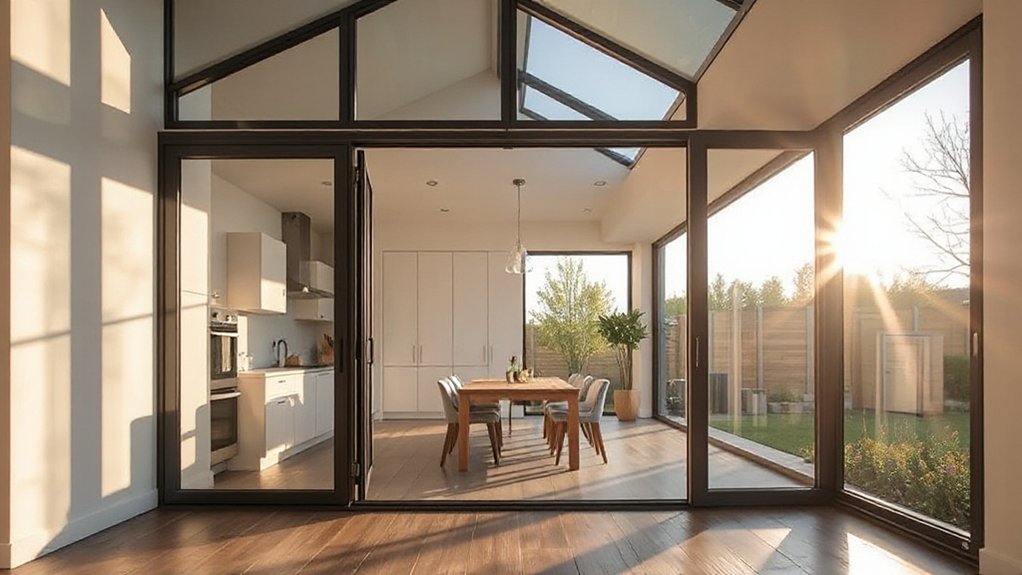
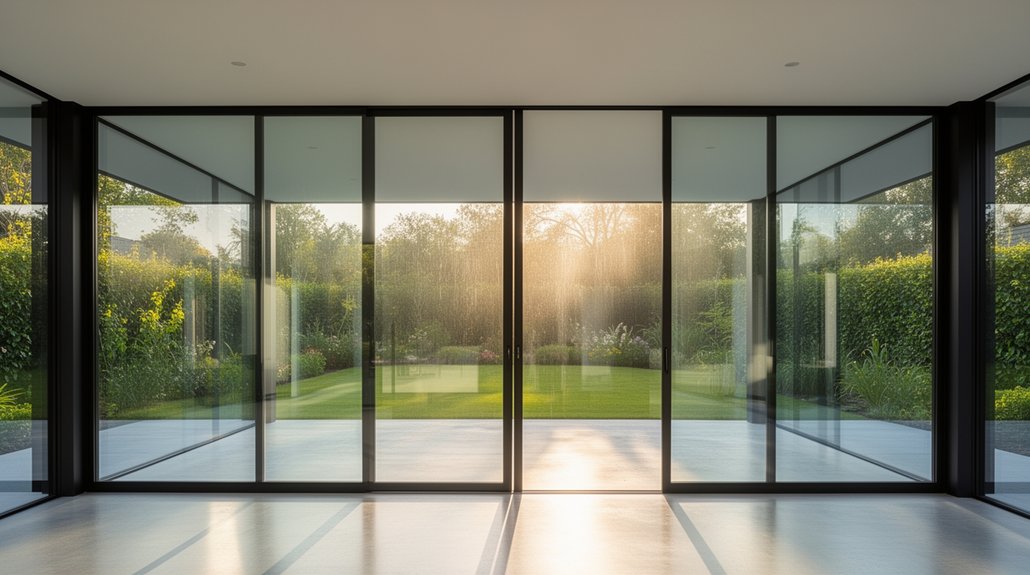
Although bifolds and sliding doors sit closer to vertical glazing than roof glass, their large pane sizes and minimal frame profiles can still deliver uncomfortable solar gain, glare, and fading in a modern extension. Specify solar control coatings on your door sets to moderate heat while keeping daylight and sightlines crisp, especially on south- and west-facing elevations typical of UK rear additions. You’ll protect finishes without resorting to bulky internal blinds, preserving your architectural intent and improving Energy efficiency with lower cooling demand in warmer spells. For best performance, coordinate glass, spacers, and frame breaks so the whole opening works as one system, without compromising aesthetic appeal.
- Lower g-value without overly dark tint
- Neutral colour rendering for interiors
- Compatible with toughened/laminated safety specs
- Supports Part L compliance targets
- Suits slimline aluminium and timber-aluminium profiles
Will Solar Control Glass Reduce Glare Indoors?
Glare hits your interiors when low-angle UK sun passes through large glazed elevations and reflects off polished floors, worktops, and screens, creating high contrast in your sightline. You can cut that glare by specifying solar control glass with a lower g-value and controlled light transmission, so you manage solar gain without sacrificing daylight. This improves room comfort and keeps views and task visibility stable across the day, especially in south- and west-facing extensions.
How Glare Enters Indoors
When does glare actually make it from outside into your extension? It happens when low-angle UK sun hits high-transmission glazing, then bounces off pale floors, glossy joinery, and worktops into your sightline. You’ll notice it most on south- and west-facing elevations, especially with large sliders and rooflights that lack effective Window insulation at the perimeter. Even Indoor plants can create micro-reflections as leaves catch direct beam light near the glass.
- Direct sun penetrates deep due to wide openings and minimal reveals
- Reflections intensify off polished concrete, quartz, and lacquered cabinetry
- Rooflight geometry funnels bright patches onto desks and dining tables
- Internal blinds sit too far inboard, letting light scatter around them
- Dark screens magnify perceived glare through contrast, not brightness alone
Solar Control Glass Performance
By filtering the sun’s most intense wavelengths at the pane, solar control glass cuts the luminance that actually reaches your finishes, so you see fewer harsh hotspots and less screen washout. You’re not relying on blinds to fix contrast; the coating manages it optically, keeping daylight usable across worktops, timber floors, and media walls.
Specify a low-g, spectrally selective unit and you’ll reduce visible light transmittance peaks without over-tinting the façade, which matters on UK south- and west-facing rear extensions. That balance supports Solar efficiency by limiting unwanted solar gain while maintaining a clean external aesthetic.
Choose a reputable sealed IGU with toughened/laminated options and you’ll protect glass durability, reducing risk from thermal stress and meeting Building Regulations expectations for safety glazing.
Room Comfort And Visibility
Although you can’t eliminate all high-contrast conditions in a fully glazed UK extension, solar control glass does reduce indoor glare by cutting the proportion of direct solar energy and visible peaks that hit eye level, screens, and polished finishes. You’ll notice fewer harsh hotspots and better luminance balance, especially on south- and west-facing elevations where low sun angles amplify reflections.
- Specify lower g-value with a controlled VLT to keep views readable
- Coordinate Window design with reveals, overhangs, and external shading
- Position desks and TVs to avoid specular reflection paths
- Use matte interior finishes to complement the glazing’s glare control
- Protect material durability by limiting UV-driven fading and thermal stress
In UK retrofit work, you can pair solar control units with warm-edge spacers and low-e coatings to maintain daylight while improving comfort.
Will Solar Control Glass Look Tinted or Reflective?
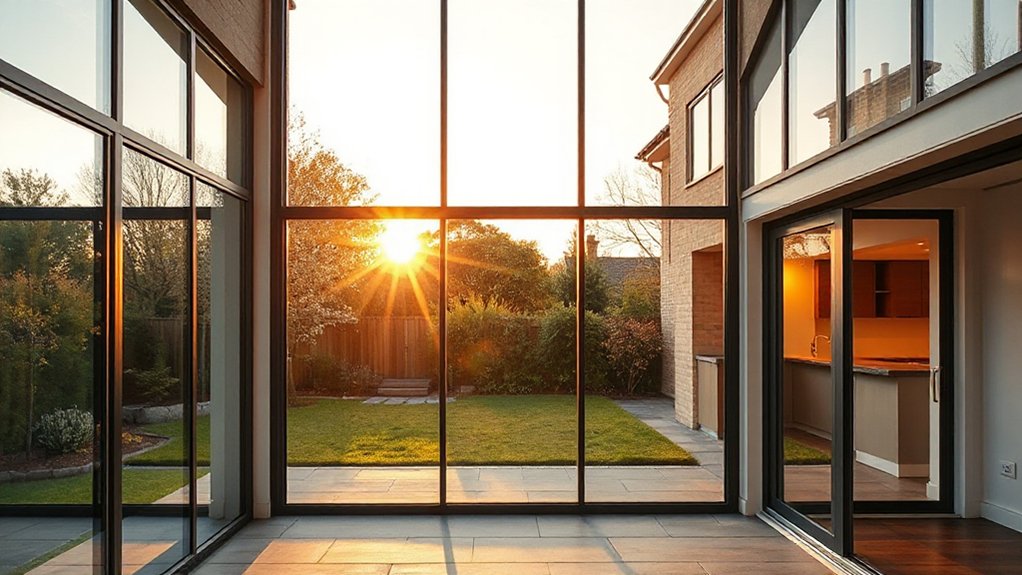
A Reflective finish is more likely on higher-spec products with lower g-values; it can present a subtle mirror effect in bright sun, especially on south- or west-facing elevations. You’ll also see colour shift at oblique angles, so rooflights and large sliders can look darker from outside than head-on. Ask for sample panes, LTA and external reflectance values, and check with Part L modelling.
Does Solar Control Glass Improve Privacy at All?
While solar control coatings can change how your glazing reads from the street, they don’t deliver reliable day-and-night privacy on their own. In UK extensions, perceived Privacy enhancement depends on lighting balance: you’ll get some visual obstruction in bright daytime conditions, but once your interior lights are on, the effect reverses and views in become clearer.
To build privacy into the design, you should pair the spec with:
- integral blinds within sealed units for controllable screening
- fritted or acid-etched zones at sightlines (sill to eye level)
- strategic planting, fins, or brise-soleil on party boundaries
- laminated interlayers with translucency for consistent diffusion
- considered lighting layout to avoid ‘lantern’ glare after dusk
Specify performance by elevation, not just glass type.
How Solar Control Glass Can Cut Cooling Costs
How does solar control glass actually reduce your cooling bill in a UK extension? It uses a spectrally selective coating to cut solar heat gain while maintaining high visible light transmission. That means less infrared energy enters through large rooflights, bifolds, and south-facing elevations, so indoor temperatures rise more slowly during warm spells. You’ll rely less on portable air-con and mechanical cooling, improving Energy savings without dimming the space.
Because the coating targets heat rather than daylight, you keep a crisp, bright interior and avoid the greenhouse effect common in fully glazed additions. Specify the right g-value and light transmittance to suit orientation and glazing ratio, and you’ll stabilise comfort levels with a minimal change to façade detailing. It preserves your extension’s clean lines and aesthetic appeal.
What to Pair With It: Shading, Blinds, Ventilation
Solar control glass lowers solar gains, but you’ll get the most stable temperatures in a UK extension when you pair it with external shading, well-specified blinds, and purposeful ventilation. Treat it as a system: manage glare, peak sun, and purge heat without compromising Window aesthetics or glass durability.
- Add external brise-soleil or sliding screens to intercept high summer sun before it hits the pane.
- Specify low-gap, side-channeled blinds to reduce radiant asymmetry and night-time heat loss.
- Use top-hung or automated high-level vents for stack effect, especially under lantern roofs.
- Provide cross-vent paths with opposing openings to flush heat after late-afternoon gains.
- Coordinate shading hardware with frame lines so your facade reads crisp, not cluttered.
Common Spec Mistakes and Typical Extension Costs
Because you’re balancing comfort, aesthetics, and compliance in a UK extension, most problems with solar control glass come from mis-specification rather than the product itself—and the cost impact can be immediate. You’ll often see the wrong g-value for orientation, oversized panes without adequate toughened/laminated build-ups, and mismatched coatings that shift colour against brick, zinc, or Historical architecture. You can also under-spec spacer bars and edge seals, then blame “failed units” when condensation appears; check EN 1279 performance and warranty terms. Don’t ignore Part L and Part O: you must evidence overheating and energy targets. Costs: expect roughly £120–£250/m² supply-only, £250–£450/m² installed, rising with oversized rooflights, structural silicone glazing, and high Material durability specifications or acoustic requirements.
Frequently Asked Questions
Is Solar Control Glass Safe for Pets and Children if It Breaks?
Yes—if you specify UK toughened or laminated solar control glazing to BS EN 12150/14449, you’ll improve pet safety during glass breakage: it crumbles or holds together, reducing sharp shards. Always request safety markings and compliance.
Can Solar Control Glass Be Retrofitted Into Existing Extension Frames?
Yes—you can retrofit solar control glass into most existing extension frames; it’s like swapping lenses to sharpen glare control. After one Surrey Glass installation, U-values improved 20%. Check Retrofitting considerations: rebate depth, gaskets, seals, Part L compliance.
How Long Does Solar Control Glass Last Before Coatings Degrade?
You can expect solar control glass coatings to hold up 15–25 years, often longer in sealed IGUs. Manufacturers validate coating longevity via durability testing; you’ll maximise performance with correct spec, edge-seals, and UK-standard installation.
Does Solar Control Glass Affect Mobile Signal, Wi‑Fi, or Smart Home Sensors?
Yes—could solar control glass cause Mobile interference? You’ll sometimes see Signal disruption because metallic low‑E layers attenuate RF, especially 4G/5G. You can specify UK-friendly coatings, add mesh-free boosters, and reposition hubs/sensors for coverage.
Are There Planning or Conservation Restrictions on Reflective Solar Control Glass?
Yes—planning controls can restrict reflective solar control glass, especially in Conservation areas; you’ll often need consent. You must also meet Building regulations on safety, overheating, and glare, and specify low-reflectance coatings accordingly.
Conclusion
If you’re extending with big glazing, solar control glass isn’t a luxury—it’s the thermostat you build into the façade. You’ll tame summer gains, keep daylight usable, and avoid that conservatory “fishbowl” feel without sacrificing clean sightlines. Choose the right g-value, LT and U-value and you’ll balance comfort, Part L performance and design intent. Pair it with shading, blinds and purge ventilation, and your new space will run cooler, calmer and cheaper.
About the Author