You can’t modernise a stone‑built gatehouse by treating it like a blank shell; you’ve got to start with a proper survey that maps structure, damp paths, and past repairs. From there, you choose breathable insulation, lime-based finishes, and glazing that’s discreet but high-performing, so you add comfort without trapping moisture or flattening the building’s character. The challenge is deciding what you reveal, what you conceal, and what you never touch—because that’s where the conversion succeeds or fails.
Key Takeaways
- Start with structural and damp surveys, mapping cracks and moisture paths to target repairs without harming historic stonework.
- Engage planning and conservation officers early, using significance maps and heritage impact statements to secure listed building consent.
- Prioritise like-for-like, minimal, and reversible interventions, aligning new insertions with existing joints and vault geometry.
- Use vapour-open insulation and lime finishes, maintaining breathability while detailing airtightness carefully to avoid trapped moisture.
- Integrate discreet glazing, lighting, and low-temperature heating, routing services through cabinets and voids to preserve fortress-like character.
Start With a Gatehouse Conversion Survey (Structure + Damp)
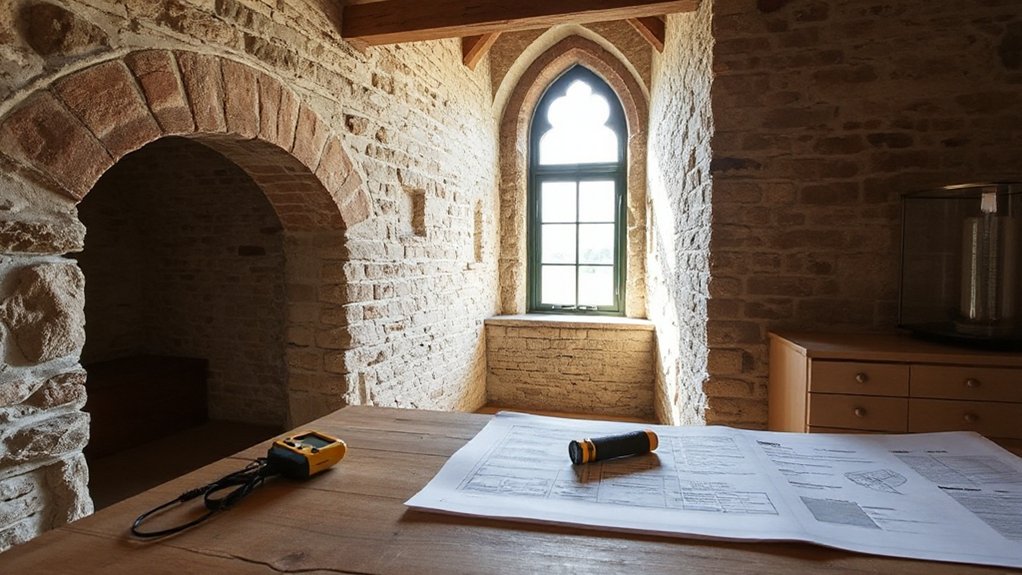
Before you sketch layouts or price up finishes, commission a conversion survey that targets both structural performance and moisture behaviour in the stone gatehouse. You’ll map crack patterns, assess lintels, arches, and wall ties, and confirm foundations and floor build-ups can take new loads. Pair this with a damp investigation: check rainwater goods, ground levels, drainage runs, and internal humidity, then test salts, capillarity, and breathability through mortar and stone. You should specify non-invasive opening-up where needed, and record defects with measured drawings and photos to protect the building’s Historical significance. The survey’s findings steer insulation strategy, ventilation, and heating so you don’t trap moisture. Prioritise Material preservation by choosing lime-compatible repairs and detailing junctions that shed water cleanly.
Check Listed Building Consent and Planning Early
Before you sketch layouts or specify finishes, you must confirm whether the gatehouse is listed and what Listed Building Consent will cover, from window alterations to internal joinery and services routes. You’ll save time and protect the design intent if you book an early pre‑application conversation with planning and conservation to test proposals against local policy and significance. Get their constraints and required documents in writing, then structure your scheme around them from day one.
Listed Consent Requirements
Although a stone-built gatehouse conversion can feel like a straightforward design-and-build project, listed status changes the rules: you’ll likely need Listed Building Consent for any work that affects the building’s character, and you may also need planning permission depending on the scope, use, and setting. Treat consent as a design constraint: specify repairs, alterations, and new insertions with the same rigor as structure and services. Map significance room-by-room, then justify each change through a clear Heritage impact statement, supported by photos, drawings, and material samples. Focus on reversibility, minimal intervention, and like-for-like stone, lime mortar, and joinery details where required. Don’t start work before approval; unauthorised changes can trigger enforcement, delays, and costly reinstatement under legal considerations. Document everything for sign-off.
Early Planning Consultation
Where do you start with a listed stone gatehouse conversion—sketches or consents? You start with an early planning consultation that tests your design against policy and the building’s historical context. Book pre-app meetings with the conservation officer and case planner, then arrive with measured surveys, condition photos, and a clear significance statement. Explain what you’ll keep, what you’ll alter, and why.
Use the session to confirm whether you need Listed Building Consent, planning permission, or both, and to agree the level of detail for drawings, heritage impact, and structural reports. Ask specifically about openings, glazing lines, services routes, and energy upgrades so you don’t redraw later. Frame proposals around material preservation: repair stone, lime mortar, and joinery before you replace anything.
Insulate a Stone Gatehouse Without Trapping Damp
- Specify vapour-open internal insulation (wood fibre, cork, or calcium silicate) to buffer humidity and reduce cold-bridge risk.
- Keep lime-based plaster and finishes; they allow drying and suit historic masonry profiles.
- Add airtightness with intelligent membranes and taped reveals, but maintain vapour permeability to the inside.
- Treat floors and roofs with breathable build-ups, then design continuous thermal lines at wall-to-floor and wall-to-roof junctions.
You’ll also manage moisture at source: repair pointing, improve rainwater goods, and keep external stonework sound.
Add Glazing to a Gatehouse Conversion (Light + Heat)
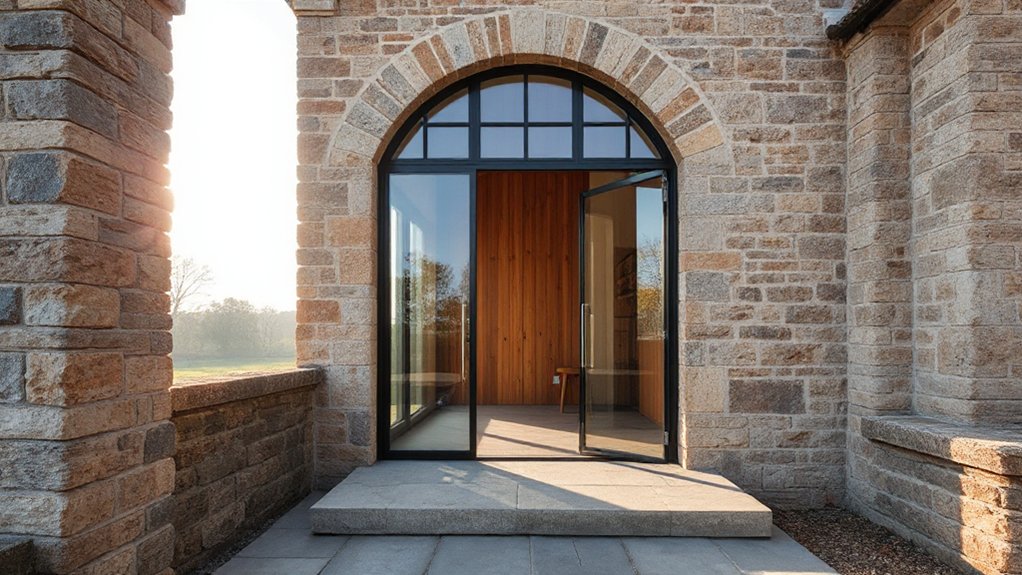
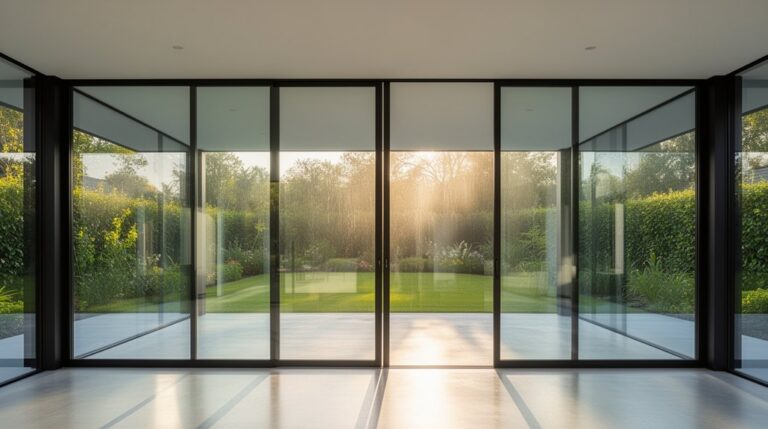
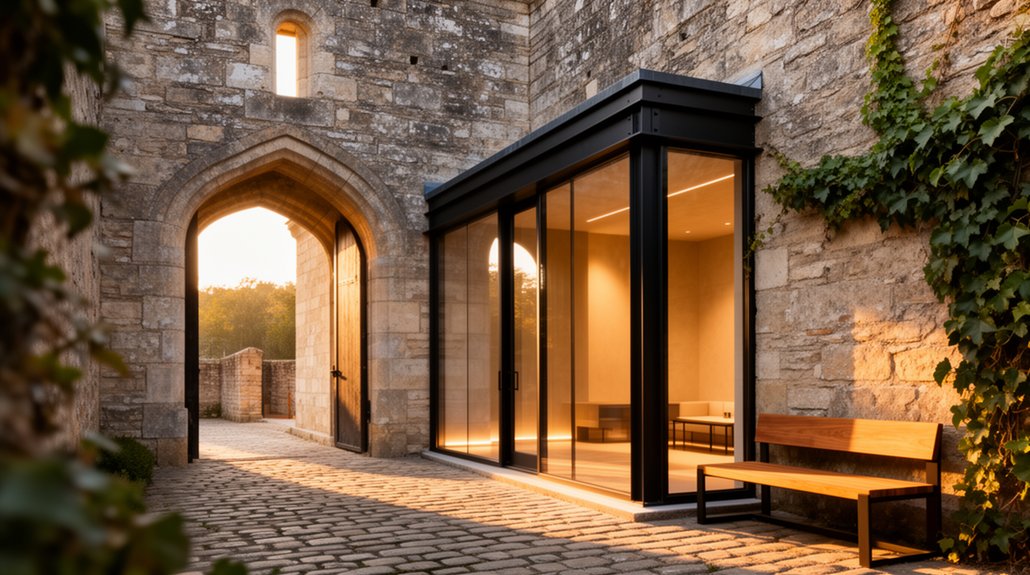
Because a stone gatehouse holds onto cold as readily as it holds onto history, your glazing strategy has to do two jobs at once: pull daylight deep into thick-walled rooms and control heat loss without creating condensation at reveals. Start with window placement: align new openings with historic axes, but bias to south and east where views allow, and keep heads high to bounce light off ceilings. Choose slim-profile frames with thermal breaks so sightlines stay crisp. For glass insulation, specify low‑E, argon-filled double or triple glazing with warm-edge spacers; target a low U‑value rather than chasing extreme g‑values that can overheat small rooms. Detail insulated cavity closers and airtight tapes at the perimeter, then ventilate the frame rebate to manage moisture. Add discreet internal blinds for night losses.
Expose Stone Walls Without Losing Heat
Although exposed masonry gives a gatehouse its drama, you can’t just strip plaster and hope for the best—you need a wall build-up that keeps the stone warm and breathable. Treat the interior as a controlled layer: keep moisture moving, stop drafts, and avoid cold bridges that trigger condensation and salt bloom. Use Stone wall insulation that respects irregular substrates and heritage fabric, then finish with vapour-open materials so the wall can dry inward.
- Survey moisture and salts before you expose anything; repair gutters and lime-point first.
- Choose capillary-active internal insulation (wood fibre or calcium silicate) to warm the stone.
- Seal junctions—reveals, floor edges, joist pockets—so heat doesn’t bypass the insulation.
- Pair the upgrade with Modern heating solutions that maintain steady temperatures, not spikes.
Fit Modern Heating Into a Gatehouse Conversion
You can’t let bulky radiators dictate the layout, so you’ll choose low-profile heat distribution—underfloor loops, slimline trench units, or discreet wall panels—that preserves sightlines to the stone. You’ll pair that with efficient, stone-compatible systems like an air-to-water heat pump, weather-compensated controls, and zoned circuits sized for high thermal mass. You’ll also manage moisture and loss with breathable insulation strategies and tight commissioning, so the historic shell stays warm without compromising the fabric.
Low-Profile Heat Distribution
How do you deliver even, modern comfort in a stone-built gatehouse without thick radiators, bulky trunking, or raised floors that spoil original thresholds? You specify distribution methods that disappear into joinery lines and ceiling planes, then pair them with low-temperature supply for steady warmth and minimal visual clutter, even in compact rooms.
- Choose slim skirting convectors where window seats or shutters rule out wall emitters.
- Use ceiling radiant panels in vaulted bays; you’ll keep walls clear for lime plaster and artworks.
- Route micro-bore pipework through service zones, stair voids, and built-in cupboards to protect historic reveals.
- Add solar thermal preheat to your buffer tank so emitters run gently, not in bursts.
You’ll feel calmer comfort, not drafts or hot spots.
Efficient Systems For Stone Walls
Because thick stone behaves like a slow thermal battery, efficient heating in a gatehouse starts with low‑temperature systems that run longer and steadier—air‑source or ground‑source heat pumps feeding a buffer and mixing valves, matched to emitters sized for 35–45°C flow. You’ll tune controls for weather compensation, then zone by exposure so north rooms don’t overheat when the south warms. Keep pipework on internal faces or in new service voids, not chased into masonry, to support stone preservation. Where you must add fixings, specify lime-compatible anchors and map historic joints before drilling. Pair insulation with hygrothermal analysis so the wall can dry, and coordinate any wall reinforcement with concealed ducts and manifolds for a clean, legible layout.
Light a Gatehouse Conversion’s Dark Corners
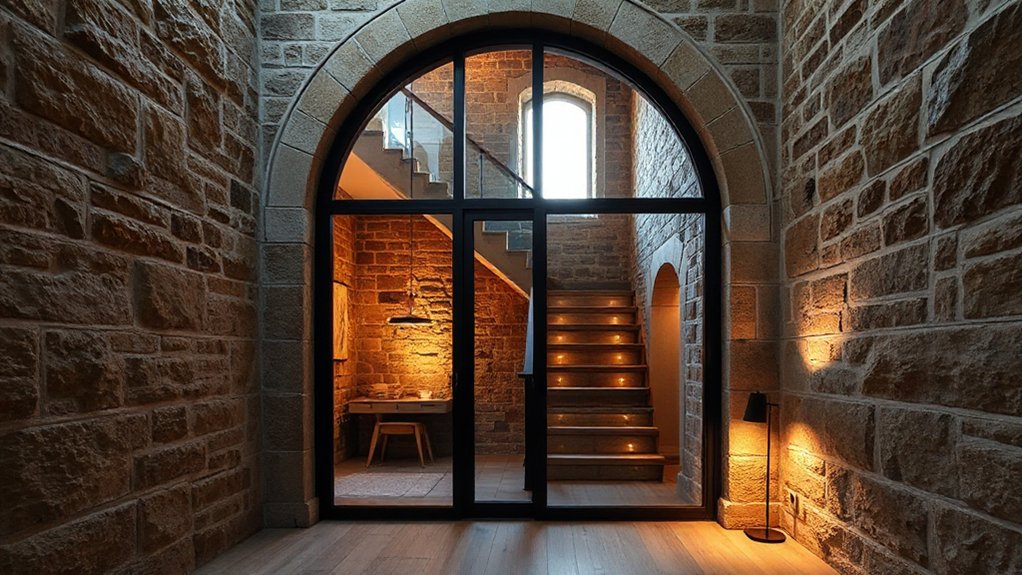
While thick stone walls and narrow openings give a gatehouse its fortress-like charm, they also cast stubborn shadows that can make renovated rooms feel cramped and unwelcoming. You’ll brighten them without undermining Historical preservation or sacrificing Modern aesthetics by layering light and controlling glare.
- Wash masonry with concealed linear LEDs at cornices or floor edges to reveal texture, not hotspots.
- Add slim uplights in corners to lift ceilings and soften heavy reveals.
- Use high-CRI (90+) warm LEDs (2700–3000K) so stone reads natural, not gray.
- Specify dimmable, scene-based controls and discreet wall washers to balance day/night.
Choose pale limewash and matte finishes to bounce light, and place mirrors opposite openings to extend daylight deeper into the room.
Plan the Layout Around Vaults and Narrow Bays
If you treat vaults and narrow bays as the fixed geometry that drives every decision, the layout starts to feel intentional instead of improvised. Begin with vault planning: map spring lines, crown heights, and thrust points so partitions never fight the curve. Keep circulation on the flattest runs, and place primary rooms where headroom is most generous. Use bay alignment to position doorways, sightlines, and furniture zones on the structural rhythm, not against it. When a bay narrows, shift functions rather than forcing standard dimensions; a reading perch can replace a full-depth seating run. Keep services in predictable bands along party walls, then thread short, straight routes between bays to avoid awkward jogs. Let each vault dictate proportions, and you’ll gain calm coherence.
Add Storage and Finishes That Suit Aged Stone
Once you start treating the stone as the “finish,” your storage and surface choices get simpler and sharper. You’ll get the best result when new work reads as quiet, precise joinery against the rugged wall texture, not as competing decoration. Keep fixings minimal, align edges with existing joints, and let shadow gaps do the detailing.
- Build full-height oak or painted-wood cabinets into narrow bays; you’ll gain Storage solutions without masking too much masonry.
- Use recessed niches with flush doors for pantry and utility; you’ll avoid bulky carcasses.
- Specify limewash, microcement, or clay plaster as Decorative finishes; they breathe and soften glare.
- Choose darkened brass, blackened steel, and honed stone tops; they echo age and handle wear.
Frequently Asked Questions
How Do You Source Reclaimed Stone to Match an Original Gatehouse?
You’ll source reclaimed stone by salvaging from local demolitions, contacting heritage yards, and commissioning a geologist’s match. Prioritize sourcing authentic rubble and test bedding planes. Specify matching historical mortar through lab analysis and trial panels.
What Are the Typical Insurance Issues During a Gatehouse Conversion Project?
Expect a surprise: insurers flag structural instability, water ingress, and listed-building compliance. You’ll need risk assessments, contractor’s all‑risks, public liability, and delays cover. Document changes, or Insurance claims get challenged on workmanship and materials.
How Can You Improve Acoustics in Vaulted Stone Rooms Without Harming Character?
You’ll tame echo by adding reversible Acoustic panels, drapes, and rugs, and by using discreet Soundproofing techniques like isolated floor underlays and sealable doors. You’ll preserve vault character by avoiding chasing stonework.
Which Contractors Are Best Suited for Heritage Stonework and Lime Mortars?
You’ll want heritage masonry contractors with proven Historical preservation portfolios, lime-mortar certification, and stonemasons skilled in Material matching. You should check SPAB/ICON affiliations, insist on sample panels, and demand references on comparable listed projects.
What Ongoing Maintenance Does a Converted Stone Gatehouse Usually Require?
You’ll baby, nurse, and obsess over it: repoint lime, monitor damp, clear gutters, inspect roofs and flashings, treat timber, ventilate, and control salts. Use Restoration techniques for cracking; prioritize Material preservation with breathable finishes, gentle cleaning, yearly surveys.
Conclusion
You’ll get the best gatehouse conversion when you survey structure and damp first, secure consent early, and insulate with breathable systems that won’t trap moisture. Add high‑performance glazing where it’s discreet, keep stone exposed selectively, and integrate low‑profile heating and layered lighting. Let vaults and narrow bays drive the plan, then choose storage and finishes that echo the masonry. Done well, old and new sit together like tailored steel within weathered stone.
About the Author