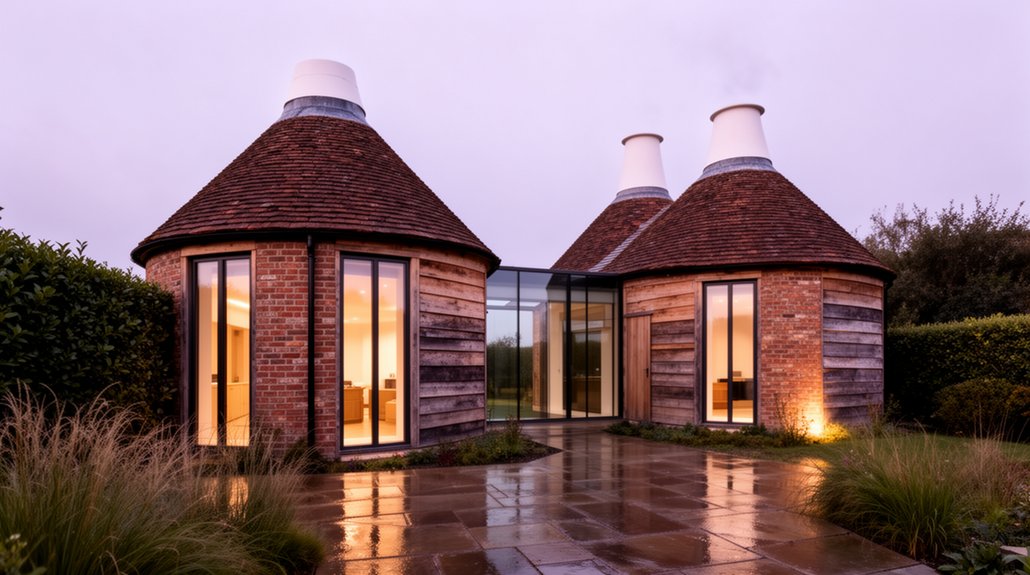
You can convert an oast house, but you’ll need the right consents and a plan that protects its skyline profile. Keep the kiln cap, cowl, and brick base intact, and avoid “tidying up” features like timber doors, hop vents, or original bonding that make the tower legible at a distance. Fit insulation, services, and bathrooms within the curves so nothing bulges outside. The real test comes when you place new openings and any extension…
Key Takeaways
- Secure change-of-use planning permission, listed building consent, and building regulations approval before altering the oast house.
- Treat cowls, kiln caps, brick kiln bases, vents, and original doors as non-negotiable features to retain.
- Design layouts that celebrate round towers, placing services in rectangular bays and living spaces in towers with views.
- Add breathable internal insulation with controlled ventilation, using service voids and hygrothermal modelling to prevent trapped moisture.
- Use slim-profile windows and lime repairs, and site any extensions low and leeward, linked by discreet glazing.
Can You Convert an Oast House? Key Permissions
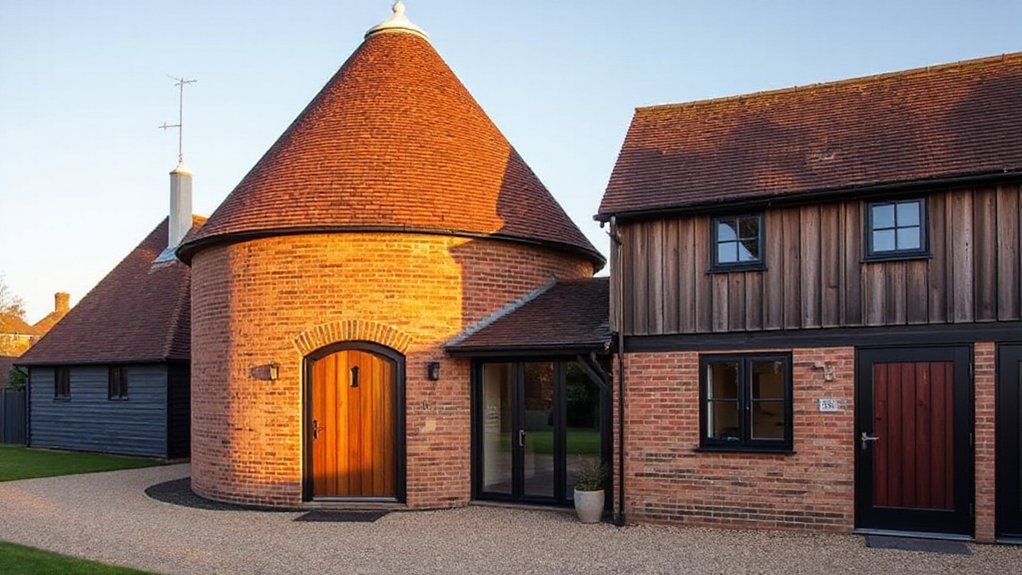
Although many oast houses can be converted, you can’t start work until you’ve pinned down the key permissions: planning permission for change of use and alterations, listed building consent if it’s protected, and building regulations approval for structure, fire safety, insulation, and drainage—plus any constraints from conservation areas, access requirements, or protected habitats that can dictate what you’re allowed to change. Next, request pre-application advice and submit drawings, a heritage statement, and a design-and-access statement where required. You’ll need survey evidence: structural report, bat and barn owl checks, and drainage strategy. Treat Historical preservation as a planning objective, not a slogan: justify every intervention. Frame Modern adaptations as reversible and proportionate, and document materials, windows, services routes, and external works early.
Oast House Features You Can’t Lose
Before you sketch new floorplans, you need to identify the oast house elements that planning officers and conservation teams will expect you to retain, because once you remove them you can’t “design your way back” to authenticity. Treat these components as non-negotiables for Historical preservation, then wrap Modern adaptations around them with reversible details and clearly documented repairs. Prioritise like-for-like materials, keep original openings where possible, and repair rather than replace to protect patina and proportions. Photograph, measure, and log every feature before you touch it, so your drawings match what’s on site.
- The conical kiln cowls and weathered caps silhouetted against the sky
- The brick kiln bases, roundels, and bonding patterns at eaves level
- The hop-drying vents, ironwork, and original timber doors with worn thresholds
Layout Ideas for Round Walls and Towers
When you plan a conversion around round walls and tower spaces, let the curve set your circulation and keep the straight, service-heavy functions in the adjoining rectangular bays. Place the kitchen, utility, and bathrooms where runs stay short; reserve the tower for living, dining, or a study where views matter. Use radial zoning: a central hearth or table anchors the room, while curved banquettes and built-in shelving follow the wall without wasting corners. For Interior decor, choose flexible pieces—round rugs, swivel chairs, and custom joinery—to avoid awkward gaps. Put stairs against the curve, and use half-landings for storage. Extend doors to a terrace; align glazing with Landscaping ideas that frame approach paths and seating.
Insulate and Ventilate an Oast House Discreetly
Because an oast house often relies on solid masonry and a distinctive roof profile, you’ll get the best performance by upgrading insulation and ventilation in ways that protect vapour movement and keep original features visually intact. Prioritise Historical preservation by using breathable, capillary-active insulation to the inside, and seal only where you can manage moisture safely. You’ll achieve Modern integration by adding controlled ventilation that’s quiet and hidden, not by over-foaming and trapping damp.
- A lime-rendered wall backed with woodfibre board, warm to the touch but still “breathing”
- A slim service void carrying airtightness tape, so masonry stays untouched and readable
- Discreet ridge or eaves vents feeding a small MVHR tucked in a cupboard, balancing humidity year-round
Commission hygrothermal modelling, then verify with blower-door and humidity logging.
Oast House Windows, Materials, and Extensions
Although an oast house’s curved walls and kiln roof make standard details awkward, you can still specify windows, materials, and extensions that meet modern performance targets without flattening its character. Set window reveals on chords, not tangents, so frames sit plumb and you avoid twisted liners. Choose slim-profile timber or steel, use arched heads where openings already read as historic, and keep glazing bars aligned to existing brick courses. Repoint with lime mortar, match brick by size and fired colour, and repair weatherboarding with breathable finishes; you’ll protect moisture balance integral to Oast house architecture. If you extend, tuck new volume into the lee side, keep eaves low, and connect via a glazed link. Let traditional craftsmanship guide junctions and flashing.
Frequently Asked Questions
How Much Does an Oast House Conversion Typically Cost per Square Metre?
You’ll typically pay £2,500–£4,500 per m² for an oast house conversion, depending on condition and spec. You must budget extra for Historical preservation and Structural reinforcement, which can push complex projects higher.
Will the Conversion Increase Resale Value Compared With Nearby Homes?
Yes—you’ll likely boost resale value if you execute well. Like a restored lighthouse, Historical preservation signals rarity while a Modern interior proves livability. You’ll outperform nearby homes when you manage planning, insulation, and finishes carefully.
Can I Add Solar Panels Without Spoiling the Oast House Silhouette?
Yes, you can add solar panels without spoiling the silhouette if you use low-profile, rear-slope mounting, match panel color, and avoid the cowls. Prioritize Historical preservation and careful Solar integration; get conservation approvals early.
How Do You Manage Acoustics and Echo Inside Circular Rooms?
You won’t lose that airy feel: you manage interior acoustics and echo management by adding soft finishes, wall panels, rugs, and curved diffusers; hang baffles; use bookcases; and place furniture asymmetrically to break reflections.
Are There Specialist Insurers or Mortgages for Converted Oast Houses?
Yes, you’ll find specialist insurers and niche mortgages for converted oast houses. You should use brokers experienced in non-standard construction, provide survey reports, demonstrate compliant conversions, and expect higher premiums, larger deposits.
Conclusion
When you convert an oast house, you’ll navigate permissions early, then protect the elements that define its skyline: kiln caps, vents, brick bases, and original doors. You’ll plan rooms that work with curved towers, not against them, and you’ll hide insulation and ventilation so the fabric can breathe. Choose windows and materials that match existing bonding, and keep extensions subordinate. Get these right, and you’ll keep its silhouette standing proud, like a lighthouse at dusk.
About the Author