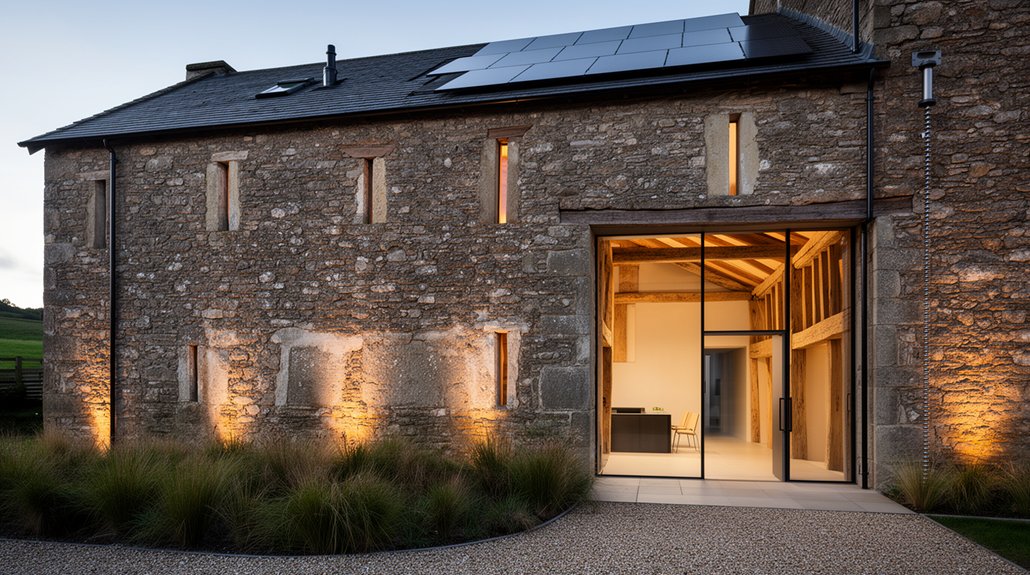
Somethin quite unique is a Medieval Bastle House, not exactly a run of the mill property, you can buy easily. You don’t have to choose between medieval authenticity and 21st‑century comfort if you treat the bastle as a breathable, repairable system. You start with a measured survey, map voids and movement, and confirm heritage constraints before you touch mortar or services. You repoint in lime, manage damp at sources, and insulate with vapour-open layers so the walls can dry. Then you hide heat, power, and ventilation where they’ll stay reversible—provided you spot the weak link first…
Key Takeaways
- Capture accurate laser-scan or photogrammetry surveys to map deformation, phases, and details, informing heritage-compliant design decisions.
- Prioritize breathable masonry repairs: remove cement, repoint in lime, stitch cracks, and replace stones with matching geology and tooling.
- Control damp at source by fixing roofs and drainage, reinstating drips, lowering ground levels, and applying sacrificial limewash.
- Add modest, vapour-permeable insulation with hygrothermal modelling to improve comfort without trapping moisture or chilling historic walls.
- Install discreet, reversible services and access upgrades using voids and linings, keeping circulation legible and fabric intervention minimal.
Survey Your Bastle House and Heritage Constraints
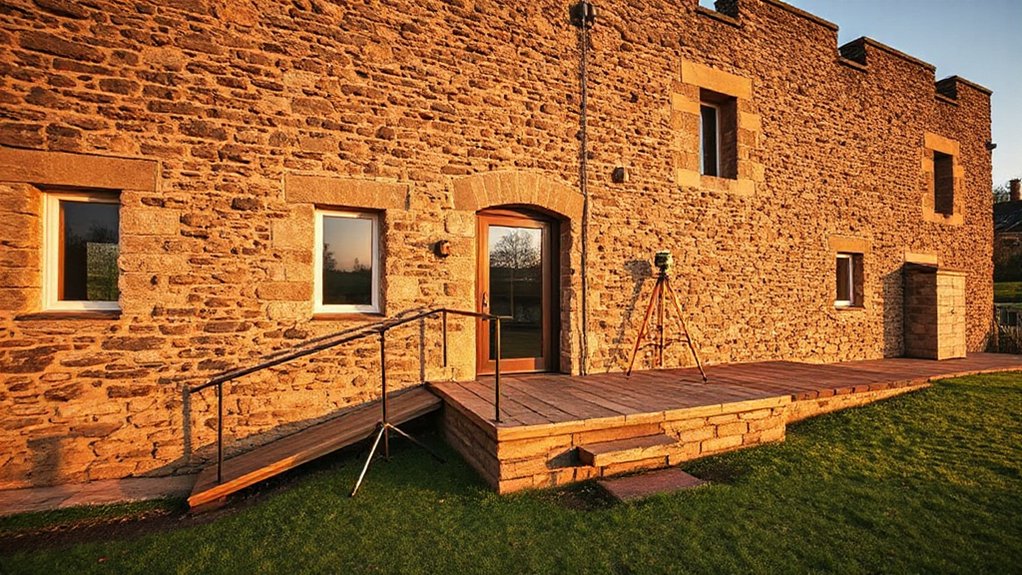
Before you design any interventions, you’ll need a measured survey that captures the bastle’s irregular masonry, wall thicknesses, openings, and floor levels, then cross-check it against heritage constraints that can govern what you’re allowed to change. Use laser scanning or photogrammetry to produce an accurate point cloud, then derive plans, sections, and deformation maps that flag bulges, settlement, and historic alterations. Record materials, tool marks, and joinery details to support Architectural authenticity, and annotate phases so you can argue Historical significance with evidence. Confirm listing status, curtilage, and setting impacts, and log requirements for consent, archaeology, and protected species. Build a digital survey register so consultants coordinate and decisions stay auditable.
Fix Bastle House Masonry, Pointing, and Damp
Your measured survey and heritage checks now give you the evidence base to treat the bastle’s fabric without guessing, so start with masonry stability, compatible pointing, and moisture pathways. Rake out failed cement carefully, avoiding edge spalling, and repoint with a lime mortar matched in binder, aggregate, and colour for Historical accuracy. Stitch cracks with stainless helical bars set in lime grout, and pin bulged faces where bedding has slid, keeping interventions reversible. Replace only fractured stones, sourcing geologically similar material and tooling to original arrises. Track damp by season: clear blocked drains, reinstate drips, repair roof leaks, and lower external ground that bridges the plinth. Use sacrificial limewash as a breathable weathering layer. These Restoration techniques align with current conservation guidance and smart monitoring.
Insulate a Bastle House Without Trapping Moisture
Because bastle walls rely on vapour-open mass to buffer rain and internal humidity, insulation has to improve thermal performance without turning the stonework into a cold, wet condensing surface. You’ll get best results with capillary-active, vapour-permeable systems and careful junction detailing, keeping medieval aesthetics while using modern insulation. Prioritise continuity, avoid impermeable foils, and model hygrothermal risk where exposure is high. Picture your approach as:
- a lime-parged inner face that evens suction and protects rubble cores
- woodfibre or calcium silicate boards bedded in mineral adhesive
- airtight but vapour-open tapes at reveals, beams, and service penetrations
- a breathable finish—limewash or clay plaster—so drying stays inward and outward
Keep insulation modest to maintain wall warmth; monitor with RH sensors through seasons.
Plan Bastle House Layout, Light, and Access
Moisture-safe insulation only performs as intended if the plan lets the building breathe and function, so tackle layout, daylight, and access as one coordinated package. Start by mapping original circulation: livestock level, defended entry, stair turret, and upper hall. Keep that logic legible for Historical accuracy, but zone modern uses with lightweight partitions you can reverse later. Prioritise daylight where openings already exist; widen sightlines internally instead of enlarging medieval windows. Use limewashed reveals to bounce light and reduce glare. For Interior lighting, layer low-energy task and ambient fittings on discreet tracks or freestanding standards, avoiding chasing into stone. Improve access by rationalising thresholds, adding slip-resistant hearth and stair treads, and designing furniture layouts that preserve clear, defensible routes while meeting today’s accessibility expectations.
Run Heating, Electrics, and Ventilation Discreetly
Although a bastle’s thick masonry can hide a lot, you’ll get a better long-term result by routing heating, electrics, and ventilation so they remain inspectable, reversible, and kind to historic fabric. Use service zones behind lime-plaster lining or within raised floors, not chased into stone. Choose Modern heating solutions—air-to-water heat pumps feeding low-temp radiators or floor plates—then isolate pipes with acoustic sleeves and vapour-open insulation. For Smart electrical systems, run surface-mounted mineral-insulated cable on discreet battens, or pull through existing voids; keep junctions accessible and label circuits for future upgrades. Ventilate with demand-controlled MVHR, but keep ducts short and oval.
- A slim skirting trunking run
- A hidden manifold cupboard
- A limewashed cable chase board
- A timber vent grille shadow line
Frequently Asked Questions
Can I Get Grants or Tax Relief for Restoring a Bastle House?
Yes, you can access grants and tax relief if you meet heritage criteria and document Historic craftsmanship. You’ll need compliant plans, costed schedules, and Conservation guidelines alignment; consult your local authority and heritage bodies.
How Do I Insure a Bastle House During Renovation and Afterward?
You insure it like wrapping stone in bubble‑wrap: get a specialist renovation policy covering works, materials, liability, and nonstandard construction. Post‑completion, switch to listed‑building cover with historic preservation clauses, factoring renovation challenges, rebuild valuations.
What Planning Permissions Are Needed for a Holiday-Let or Airbnb Use?
You’ll typically need change-of-use planning consent for short-term letting, plus listed-building consent and building regs approval. Consult Historic preservation officers, specify Sustainable materials, and check local tourism licensing, fire safety, and accessibility standards.
How Can I Add Modern Plumbing Without Damaging Historic Fabric?
Route modern plumbing through existing voids, redundant chimneys, or reversible surface chases, and avoid chasing masonry. Use low-profile PEX, leak-detection, and isolation valves. Document all work for historic preservation, and specify breathable lime-compatible finishes.
What Ongoing Maintenance Schedule Best Prevents Future Decay in a Bastle?
Treat your bastle like a lighthouse: you’ll follow a quarterly cycle—clear gutters, inspect roof/slates, ventilation, and drains; annually repoint lime, check timbers, monitor moisture/salts. You’ll log Historical preservation and Structural reinforcement findings, trend-aware.
Conclusion
You’re fundamentally tuning a medieval machine for modern life, like fitting a precision engine into a stone shell. You’ll survey and document fabric, then repair masonry with lime mortars, crack-stitching, and like-for-like stone. You’ll manage damp at source and insulate with vapour-open build-ups to avoid trapped moisture. You’ll rework layout for daylight and access, then route low-impact, reversible services behind lime linings or within floors, keeping heritage values intact.
About the Author