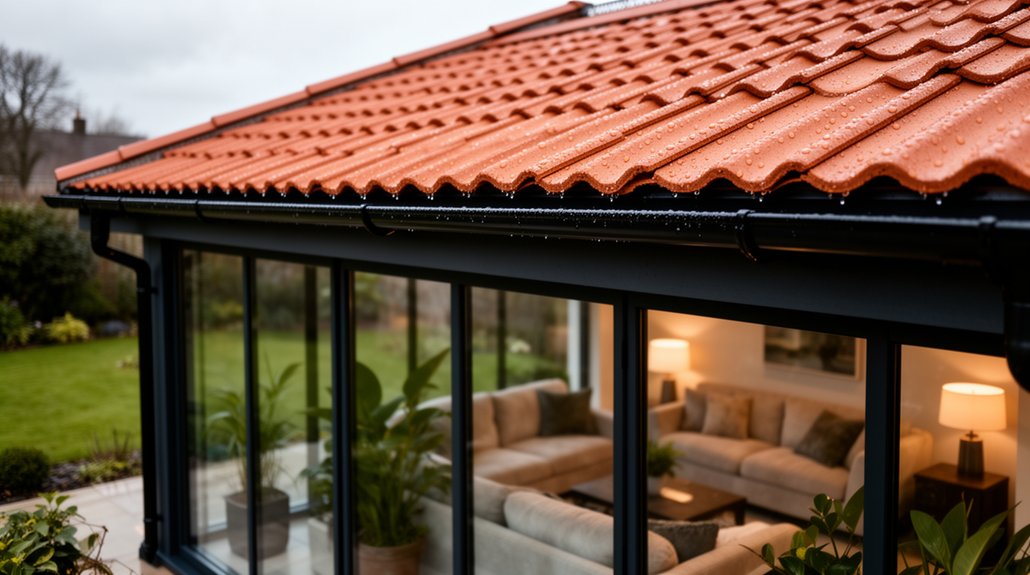
You’ll get true year-round comfort with a tiled conservatory roof because the insulated, breathable build-up creates a continuous thermal and air barrier, cutting winter heat loss and summer solar gain. You’ll also reduce glare, UV fade, and rain noise, while durable tiles and correct ventilation lower condensation risk and maintenance over time. Although costs often run £7,000–£15,000 (and more for larger designs), improved usability and energy efficiency can justify it—next, you’ll see what to check before upgrading.
Key Takeaways
- Tiled roofs dramatically improve insulation and lower U-values, keeping conservatories warm in winter and cooler in summer.
- Reduced heat loss and solar gain cuts heating and cooling bills, making year-round comfort more affordable.
- Ventilated roof build-ups with ridge and eaves detailing prevent condensation and overheating, improving indoor air quality.
- Durable tiles and membranes resist weathering, lowering long-term maintenance costs and extending roof lifespan.
- A solid, home-matching roof boosts appearance, compliance confidence, and resale value compared with ageing glazed conservatory roofs.
Are Tiled Conservatory Roofs Worth It?
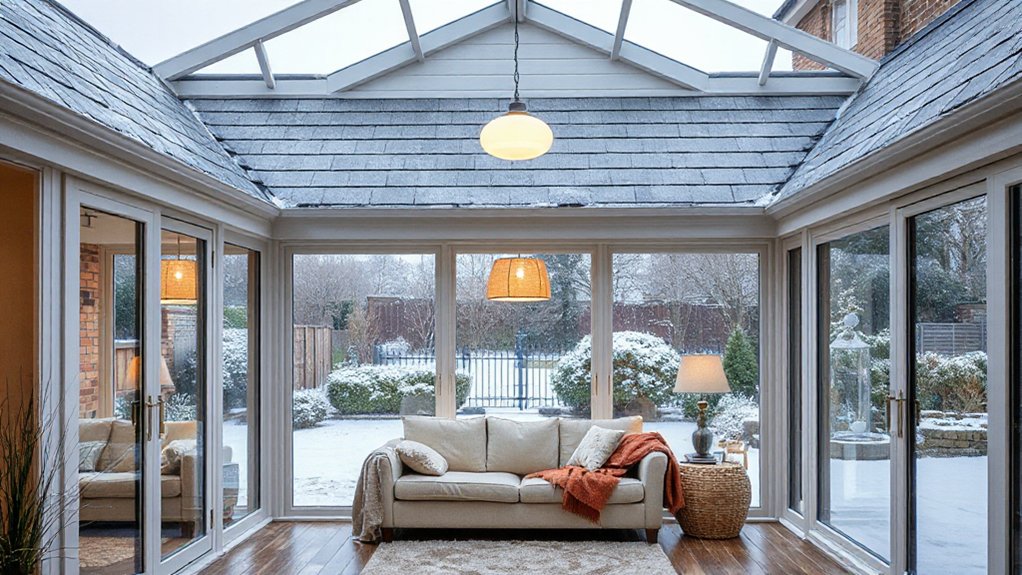
Why do so many homeowners replace a glazed conservatory roof with tiles? You’re usually chasing controlled performance, not just a cosmetic change. A tiled system lets you specify insulation levels, ventilation routes, and vapour control so the room behaves more like the rest of your house. You’ll reduce solar gain peaks, winter heat loss, and persistent glare that makes the space hard to use. Structurally, you must confirm rafter capacity, wall plate fixing, and load paths before you commit; a survey prevents deflection and cracking later. You also need to weigh garden aesthetics: tiles can integrate with your main roofline, avoiding a “bolt-on” look. Finally, consider roof maintenance—access, guttering, and flashing details should be designed for straightforward inspection and repair.
Top Benefits of a Tiled Conservatory Roof
A tiled conservatory roof pays off when you want the space to perform like a proper room, not a seasonal suntrap. You’ll stabilise internal temperatures because the insulated build-up reduces heat loss, limits solar gain, and cuts cold-bridge risk at rafters and eaves. You’ll also notice quieter use: the layered system dampens rain and wind noise, so calls and TV stay clear. Structurally, you get a rigid deck that supports secure fixings, tidy plasterboard finishes, and straightforward maintenance access at the ridge and abutments. You can specify Roof color options to match the main house for planning-friendly integration and better kerb appeal. Add Decorative finials to finish the ridge line without compromising weathering. Overall, you gain predictable comfort, durability, and a cleaner interior aesthetic.
Tiled vs Glass Conservatory Roofs: Key Differences
Two roof types dominate conservatory upgrades—tiled and glass—and they behave very differently once you factor in insulation, solar control, acoustics, structure, and planning impact. A tiled roof uses insulated panels and a ceiling finish, so you’ll stabilise temperatures and reduce overheating and winter heat loss. Glass prioritises daylight and sky views, but you’ll often need solar-control glazing, blinds, and upgraded ventilation to manage glare and peak loads. Tiled systems add dead load, so you must verify rafters, ring beams, and foundations; glass is lighter but can drive higher summertime internal temperatures. Planning-wise, roof colors and tile patterns can help you match the main house and reduce visual impact, while large glass areas may look more like an extension.
- Thermal performance
- Noise and comfort
- Structural and appearance impact
Tiled vs Polycarbonate Roofs: Key Differences
Although both options can refresh an ageing conservatory, tiled and polycarbonate roofs perform very differently once you look past upfront cost. Polycarbonate sheets transmit light but they’re prone to drumming in rain, rapid heat gain in summer, and faster heat loss in winter, so your space feels less stable and your HVAC works harder. A tiled roof uses layered insulation and a solid deck, cutting glare, improving acoustic dampening, and holding a steadier internal temperature year-round.
You’ll also notice differences in Color options: tiles offer broader, roofline-matching finishes, while polycarbonate is limited to clear, opal, or tinted panels that can yellow over time. Finally, compare maintenance requirements—polycarbonate needs regular cleaning and seal checks; tiled systems mainly need periodic guttering and flashing inspections.
Will Your Conservatory Structure Take Roof Tiles?
Before you commit to a tiled conservatory roof, you need to confirm your existing frame can safely carry the extra dead load and transfer it to sound foundations. Roof tiles, battens, and insulated panels weigh more than polycarbonate, so you must verify rafters, ridge beam, wall plate fixings, and support posts. A survey should also check for deflection, corrosion, and inadequate anchorage that could compromise roof durability.
- Load assessment: You’ll need calculated dead, wind, and snow loads, not estimates.
- Material compatibility: You must match timber/steel members, connectors, and roof system to prevent differential movement and galvanic issues.
- Foundation check: You should confirm base widths, bearing capacity, and settlement history before upgrading.
How Tiled Conservatory Roofs Keep Heat In
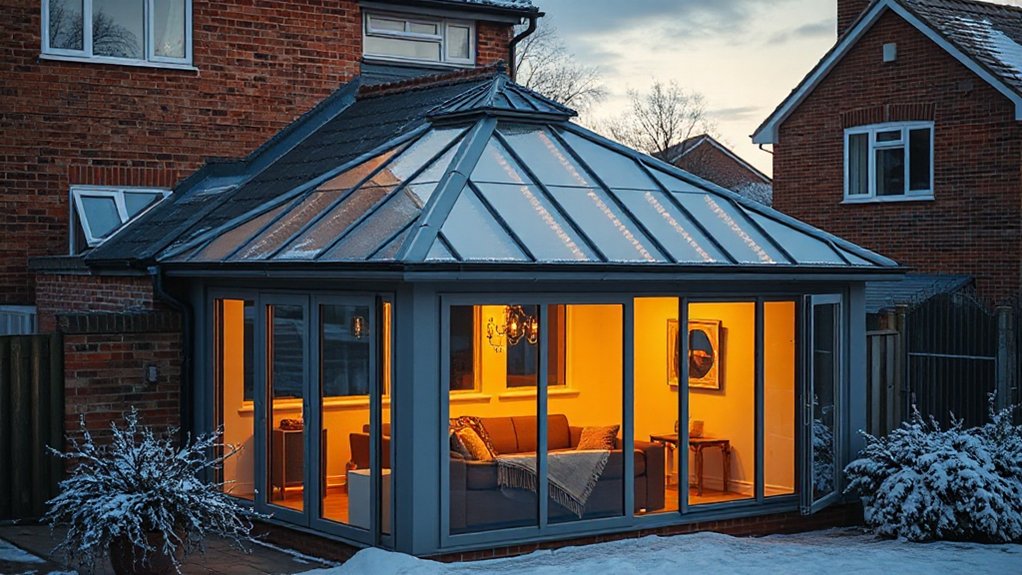
To keep heat in, you need a tiled conservatory roof build-up that uses high-performance insulation layers to slow conductive heat loss. You’ll also minimise reduced thermal bridging by specifying insulated rafters, warm-edge details, and continuous insulation across junctions. You then lock performance in with airtight seals at eaves, ridge, and abutments, while controlling moisture through designed ventilation paths that don’t compromise airtightness.
High-Performance Insulation Layers
When you replace a glass or polycarbonate roof with a tiled system, the biggest thermal upgrade comes from its multi-layer insulation build-up. You’ll trap warm air, slow conductive heat loss, and stabilise room temperature so heating cycles less often. A typical specification combines reflective membranes, rigid insulation, and an internal lining to deliver a low U-value without sacrificing headroom or daylight balance.
- Outer weather layer: lightweight tiles plus underlay shed rain while limiting wind-driven cooling.
- Core insulation: PIR or equivalent boards provide high R-value per millimetre, keeping heat where you want it.
- Internal finish layer: insulated plasterboard supports Decorative finishes, and you can coordinate Roof color options for consistent aesthetics and performance year-round.
Reduced Thermal Bridging
Although insulation does most of the heavy lifting, you’ll only keep that performance if the roof structure minimises thermal bridging—those direct heat-loss paths created where rafters, fasteners, and perimeter frames cut through the insulation layer. A tiled conservatory roof helps by using warm-deck build-ups, insulated plasterboard, and continuous underlay systems that keep the thermal line unbroken across the span. You’ll also reduce cold spots at eaves and junctions with insulated ring beams and thermally broken fixings, so internal surface temperatures stay higher and condensation risk drops. If you add solar panels, specify mounting points that avoid compressing insulation and use isolated brackets where possible. You’ll still get a roof that complements exterior decor without sacrificing U-value performance.
Airtight Seals And Ventilation
Reducing thermal bridges protects your insulation’s U‑value on paper, but you’ll only feel the benefit if the roof also controls air leakage. A tiled conservatory roof must act as a continuous air barrier, so you stop warm air exfiltration and the cold drafts that drive up heating demand. Specify Airtight seals at eaves, ridge, glazing interfaces, and service penetrations, and insist on taped membranes where needed to maintain continuity. Then manage moisture safely: if you seal the roof, you must also control indoor humidity and purge stale air with designed Ventilation systems.
- Use compressible gaskets plus compatible sealants at all junctions.
- Maintain an unbroken air‑tightness line through corners and fixings.
- Fit background or MVHR ventilation to prevent condensation and mould.
How Tiled Conservatory Roofs Stay Cooler in Summer
Because a tiled conservatory roof uses dense, layered materials instead of large expanses of glazing, it limits solar heat gain at the roofline and keeps internal temperatures more stable through summer peaks. You benefit from higher thermal mass and controlled conductivity, so heat moves into the space more slowly. With correct build-up—tile, breathable membrane, insulated core, and plasterboard—you create a continuous barrier that reduces hot spots and stops radiant heat from dominating the room. Specify finishes with strong solar reflectance to reject more incoming energy before it’s absorbed. The ventilated void and eaves detailing encourage convective airflow, improving heat dissipation without relying solely on open windows. As a result, your cooling load drops, and the room stays usable during afternoon highs.
How Tiled Roofs Cut Glare and UV
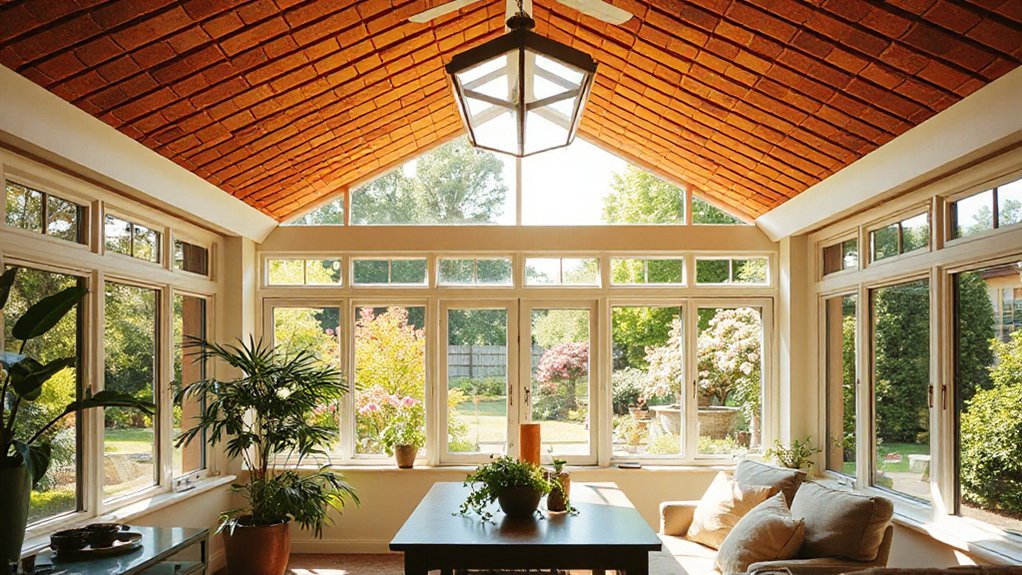
When you replace a glazed roof with a tiled build-up, you sharply reduce direct beam transmission, so the conservatory stops acting like a light box. The opaque deck blocks high-angle sunlight that causes solar glare on screens and polished surfaces, while the insulated layers limit stray reflections that wash out contrast. You’ll also cut UV exposure that fades fabrics, flooring, and artwork, because the roof assembly forms a continuous barrier rather than a large transmitting aperture.
- Specify a foil-faced underlay or radiant barrier to suppress secondary glare and improve UV protection at junctions.
- Use integrated soffit-to-ridge ventilation with light baffles, so airflow continues without reintroducing hotspots.
- Pair the roof with neutral wall glazing or low-E glass to balance daylight and reduce remaining UV load.
How Much Quieter Is a Tiled Conservatory Roof?
Although you’ll still hear heavy downpours, a tiled conservatory roof typically makes the room markedly quieter than polycarbonate or standard glazed panels by adding mass, damping, and an insulated cavity that breaks up vibration paths. In practice, you’ll notice less “drumming” from rain and far less rattling in wind because the tile layer and deck don’t flex like thin sheets. For stronger Roof noise reduction, you’ll specify mineral wool between rafters, resilient bars, and an acoustic plasterboard ceiling; these Soundproofing techniques decouple the inner lining from the outer roof, cutting structure-borne noise. Pay attention to detailing: seal penetrations, tape vapour layers, and use compressible gaskets at wall plates to stop flanking paths. If you’ve got skylights, choose laminated glass to keep performance consistent.
Will a Tiled Conservatory Roof Block Light?
A tiled conservatory roof doesn’t just cut rain noise; it also changes how daylight enters the space by replacing a largely transparent roof with an opaque build-up. You won’t get the same overhead brightness as polycarbonate or glass, but you can still achieve strong Light penetration if you plan the elevations and glazing correctly. The goal is to shift daylight to the vertical faces, not lose it.
- Specify high-transmittance, low-iron rooflights or lantern sections where structure allows, keeping U-values compliant.
- Maximise side glazing: slimmer frames, taller panes, and clear coatings deliver more usable lux at seating height.
- Use reflective internal finishes and pale flooring to bounce daylight deeper, while easing Privacy concerns without heavy blinds.
Ventilation Options for Tiled Conservatory Roofs
To manage heat build-up and condensation under a tiled conservatory roof, you’ll need a defined ventilation path from eaves to ridge. You can specify roof vent options such as tile vents or vented soffits to deliver controlled intake and mid-span extraction where it’s needed. For consistent high-level exhaust, you’ll typically rely on ridge ventilation systems that maintain airflow along the roofline without compromising weatherproofing.
Roof Vent Options
How do you stop a tiled conservatory roof from trapping heat and moisture without compromising its insulated performance? You specify roof vent options that balance purge airflow with airtightness, then position them to create predictable cross-venting above the insulation line. In a Tiled conservatory, you’ll typically combine manual control with humidity-driven boost, keeping internal temperatures stable while preventing interstitial condensation.
- Manually operated roof vents: Fit near the high point to dump hot air quickly; choose thermally broken frames and insulated upstands to minimise cold-bridging.
- Electric or solar actuated vents: Add rain sensors and timed opening so you can ventilate safely when you’re out.
- Trickle vents or eaves ventilators: Provide constant low-rate airflow; pair with insect screens and closable baffles for winter control.
Ridge Ventilation Systems
Roof vents give you targeted purge and background airflow, but ridge ventilation systems handle the highest-pressure, hottest zone in a tiled conservatory roof with a continuous, controlled exhaust path. You fit a ventilated ridge cap with baffles and weatherproof membranes, so warm, buoyant air can exit along the full ridge line without driving rain ingress. This boosts airflow management because you reduce stagnant pockets at the apex, where heat soak and condensation risk peak. Pair ridge systems with low-level inlets (trickle vents or eaves vents) to create a reliable stack effect, even when windows stay closed. Specify insect mesh, vapour-permeable underlay, and tested wind uplift ratings. You’ll stabilise internal temperatures, protect timbers, and cut mould-friendly humidity year-round.
Best Insulation for Tiled Conservatory Roofs
Although tiled conservatory roofs already improve thermal stability over glass or polycarbonate, the insulation you choose ultimately determines whether the space stays comfortable year-round. Prioritise products with high thermal performance, low moisture uptake, and verified fire ratings, then match them to your rafter depth and ventilation strategy.
- PIR rigid boards: Deliver excellent U-values in slim build-ups. You’ll need tight cutting, taped joints, and a continuous vapour control layer to prevent convection and interstitial condensation.
- Mineral wool: Offers robust acoustic damping and good fire behaviour. Use friction-fit batts, avoid compression, and maintain an air gap where specified.
- Multi-foil systems: Work only when you create sealed reflective cavities. Follow manufacturer installation techniques precisely or performance collapses.
How Much Do Tiled Conservatory Roofs Cost?
Most homeowners pay more for a tiled conservatory roof than a like-for-like polycarbonate or glass swap, because the price includes structural reinforcement, insulation build-up, and heavier external finishes. Expect quotes to vary mainly by roof area, access, and whether your existing frames need strengthening. As a working range, you’ll often see £7,000–£15,000 for small-to-medium conservatories, rising to £20,000+ for larger spans, complex valleys, or bespoke lantern sections. You’ll pay extra for premium tile systems, upgraded internal plasterboard finishes, and integrated ventilation. Your Color options also affect cost: standard grey and black are cheaper than heritage blends. Maintenance costs stay predictable, but budget for gutter clearing, periodic seals, and occasional tile replacement.
Do Tiled Conservatory Roofs Cut Energy Bills?
When you replace a glazed conservatory roof with a tiled, insulated build-up, you typically cut heat loss fast because you’re moving from a thin, high‑U-value surface to a multi-layer system designed to meet modern thermal targets. That improves winter retention and reduces summer solar gain, so your heating and cooling loads drop.
- Lower U-value, steadier room temps: insulation plus airtight membranes reduce convective drafts and radiant chill, so you run the thermostat lower.
- Better control of overheating: a ventilated void and reflective layers limit peak temperatures, cutting fan or AC use.
- Fewer efficiency penalties over time: choose durable Color options that resist fade, and follow maintenance tips like clearing gutters and checking flashing to keep insulation dry and performing.
Planning Permission and Building Regs Explained
Lower heat loss and steadier temperatures make a strong case for a tiled conservatory roof, but you’ll only keep those gains if the upgrade complies with UK planning rules and Building Regulations. In most cases you won’t need planning permission if the conservatory stays within permitted development limits, but you must check conditions on listed buildings, flats, or Article 4 areas, and confirm external changes won’t harm roof aesthetics.
Building Regs matter even when planning doesn’t. You’ll need compliant structural loading, insulation U-values, ventilation, and safe glazing where applicable, plus electrical certification for any altered lighting. If you keep the separating doors and the space remains unheated, requirements can differ. Get written confirmation and completion paperwork; it protects resale and clarifies Maintenance requirements.
Install Time, Pitfalls, and Choosing the Right Installer
Although a tiled conservatory roof can often go on in a matter of days, your actual install time hinges on survey accuracy, structural prep, weather exposure, and how much remedial work the existing frames need—so you’ll want an installer who can spell out the sequence (strip-out, strengthening, roof build, insulation, weathering, and making-good) and the risks.
- Verify load calculations: You need confirmed rafter sizing, ring-beam condition, and tie-in details to avoid deflection, cracking, and callbacks.
- Manage moisture and ventilation: Specify breather membranes, eaves vents, and airtightness to prevent condensation and future Roof maintenance issues.
- Choose proven systems: Ask for datasheets, warranties, and references that evidence tile durability, plus clear snagging, waste removal, and handover documentation.
Frequently Asked Questions
Do Tiled Conservatory Roofs Increase Property Value and Saleability?
Yes, you’ll typically boost property value and saleability by installing a tiled conservatory roof. You improve energy efficiency, reduce heat loss, and enhance year-round comfort. You also raise aesthetic appeal, signalling quality and lowering buyer objections.
What Maintenance Do Tiled Conservatory Roofs Need Over Time?
You’ll do minimal upkeep: inspect tiles and flashing yearly, clear gutters and Drainage systems, reseal joints as needed, and replace cracked tiles promptly. Check Roof insulation for damp or compression, and ventilate to prevent condensation.
Can a Tiled Conservatory Roof Integrate Solar Panels or Roof Windows?
Yes—you can add solar panel integration and roof window options on a tiled conservatory roof. You’ll need a structural load check, rafter spacing review, and proper flashing. You must route cabling, maintain ventilation, and guarantee watertight penetrations.
Are There Colour and Tile-Style Options to Match My Home?
Yes—you can match it: your roof becomes a chameleon skin, blending in. You’ll choose Color options from standard ranges, and select Tile styles like slate-effect, clay, or concrete profiles to align with your façade.
What Warranties and Guarantees Should I Expect From Installers and Manufacturers?
You should expect written Warranty coverage on materials (typically 10–25 years), installer workmanship guarantees (2–10 years), and manufacturer assurances against defects, water ingress, and fading. Confirm terms cover labour, exclusions, transferability, and claim procedures.
Conclusion
You don’t just swap a roof; you fit a shield and a thermostat in one. With tiles overhead, your conservatory stops acting like a greenhouse in July and an icebox in January. You gain steadier temperatures, quieter rainfall, and lower heat loss—often cutting bills when insulation and ventilation are specified correctly. Check your structure, meet Building Regs, and use an installer who details loading, U-values, and drainage. Then your space works year-round.
About the Author